Use of Cookies

The Royal Collections Gallery uses its own and third-party cookies, mainly for technical purposes, which are necessary to provide our services and provide you with relevant content. More information in our cookies policy. Cookies Policy.

ACCEPT to confirm that you have read the information and accepted their installation. You can change your browser settings.

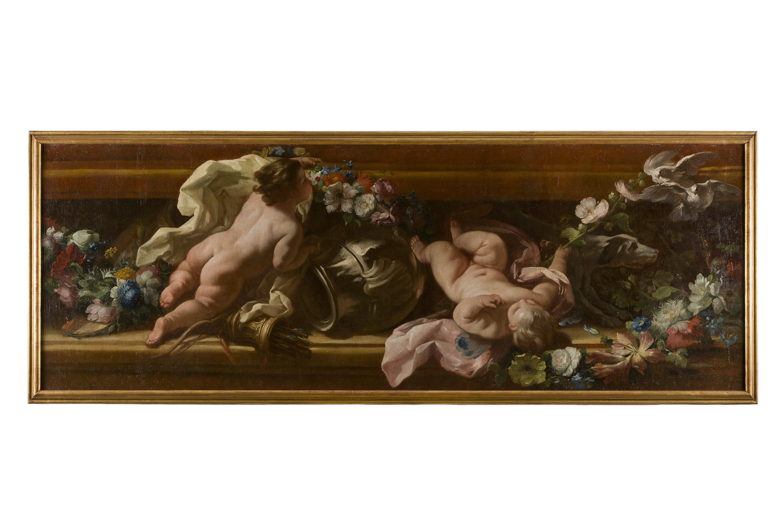
Putti con guirnalda de flores

Giaquinto, Corrado
Documentado en 1756

Como primer pintor de cámara de Fernando VI, el napolitano Corrado Giaquinto (1703-1766) fue el encargado de supervisar los trabajos de pintura realizados para la madrileña Real Fábrica de Tapices de Santa Bárbara. Sin embargo, en las series de David, Salomón y Absalón se ocupó él mismo de pintar los motivos decorativos que serían tejidos en los centros de las cenefas inferiores de los tapices. Este «cartón», que quedó en la Real Fábrica y fue adquirido por Patrimonio Nacional en 2015, sirvió para la representación del centro de la cenefa inferior del tapiz de «La muerte de Absalón» (inv. 10005883).

La escena muestra a dos «putti» desnudos tirados por el suelo, con un jarrón plateado volcado entre ellos. Con colorida guirnalda de flores que recorre horizontalmente la cenefa, el «putto» de la izquierda tiene debajo un arco y el carcaj con flechas. El otro, con alas de mariposa y tumbado boca arriba, tiene tras él un perro de caza.

La escena principal del tapiz, que se exhibe al lado y que ocupa casi todo el paño, está tomada del Antiguo Testamento, del segundo libro de Samuel. Reproduce una pintura de Luca Giordano en el Palacio de Aranjuez (inv. 10029203), aunque los liceros se sirvieron de la copia realizada para la Real Fábrica bajo la dirección de Giaquinto, acaso por Francisco Mela, quien consta trabajó como cartonista para la Real Fábrica bajo la supervisión del napolitano, al igual que Francisco Díaz, Lorenzo Medina, Santiago Müller, Agustín Ortiz y José del Castillo. Esa copia de «La muerte de Absalón» es propiedad del Museo Nacional del Prado (cat. P007377).

General Classification

Pintura mitológica

Type of Object

Cuadro

By

Giaquinto, Corrado

Title

Putti con guirnalda de flores

Era / Cultural Context

Reinado de Fernando VI

Place of Production

Italia

Date

Documentado en 1756

Display

Lienzo

Technical

Pintura al óleo

Dimensions

Fondo completo: (Altura: 84,6 centímetros; Anchura: 241 centímetros)

Inventory

10233217

Credits

Texto: Javier Jordán de Urríes y de la Colina; Foto: Mario Sedeño

Discover it at the Planta -2

Authors and Collectors

Giaquinto, Corrado
The Author

Giaquinto, Corrado

(Molfetta, 1703 - Naples, 1766)

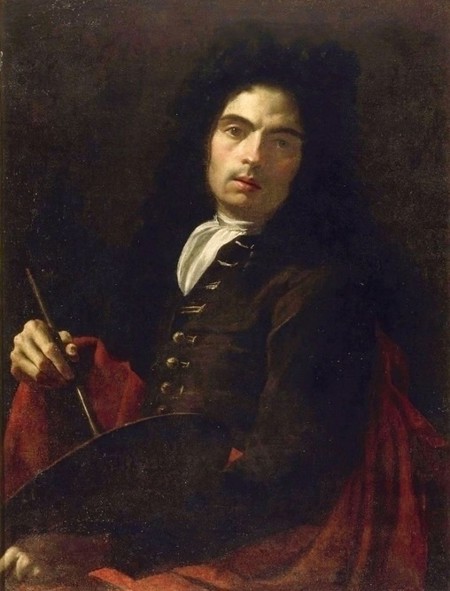
Giaquinto, Corrado. Molfetta (Italy), 18.II.1703 – Naples (Italy), 1766. Painter.

He was born in a small town near Bari, in the region of Apulia in southern Italy, in a territory which, at the time was culturally subject to the artistic interests of Naples, the nearest city. Although he had been born into a family without any involvement in the arts, his father being a tailor from Manfredonia, his parents tried to persuade him to enter the church, although they had discovered his artistic vocation at an early age. In this regard, his encounter with the Lombard architect and notable mathematician, Ludovico Vittorio Iacchini, who was, at the time, Master of the Order of Saint Dominic, was to...
Read more
Ferdinand VI
Monarch

Ferdinand VI

(Madrid, 1713 - Villaviciosa de Odón (Madrid), 1759)

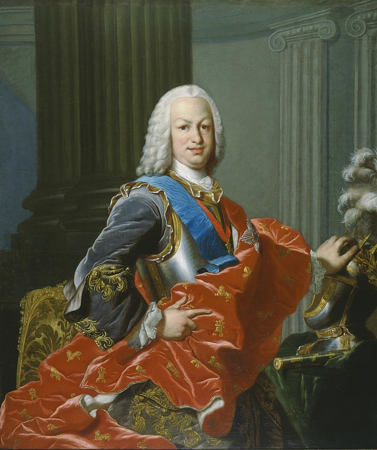
The fourth and last son of Philip V (1683-1746) and his first wife, Queen Maria Luisa Gabriella of Savoy (1688-1714), the future Ferdinand VI lost his mother when he was less than five months old. As was customary at the time, he spent his early years being cared for by a group of palace maidservants until Philip V ordered that he be placed "in a separate room to be served and attended by men only”, in 1721. That same year, the Count of Salazar and Carlos Arizaga were respectively appointed caretaker and assistant caretaker to the Infante, while the Jesuit priest Ignace de Laubrussel was appointed his tutor. From then on, the Infante Ferdinand’s training would be stricter and more planned,...

Read more

The work in context

View in Timeline