Loading...

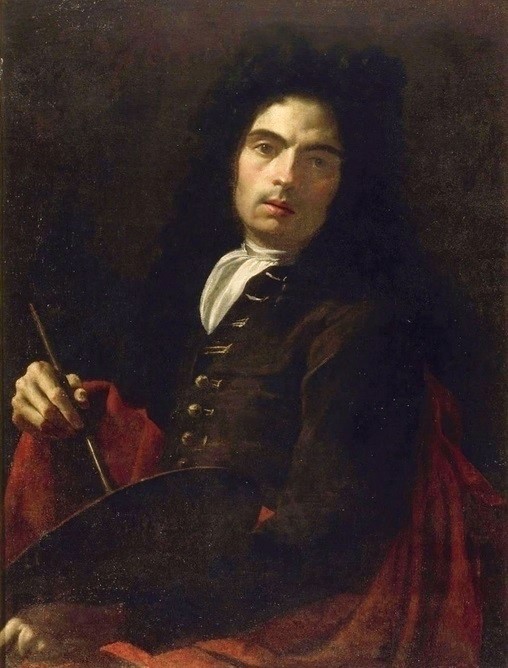
Giaquinto, Corrado
(Molfetta, 1703 - Naples, 1766)
Giaquinto, Corrado. Molfetta (Italy), 18.II.1703 – Naples (Italy), 1766. Painter.
He was born in a small town near Bari, in the region of Apulia in southern Italy, in a territory which, at the time was culturally subject to the artistic interests of Naples, the nearest city. Although he had been born into a family without any involvement in the arts, his father being a tailor from Manfredonia, his parents tried to persuade him to enter the church, although they had discovered his artistic vocation at an early age. In this regard, his encounter with the Lombard architect and notable mathematician, Ludovico Vittorio Iacchini, who was, at the time, Master of the Order of Saint Dominic, was to be a turning point. The two met during the period when Iacchini was living in Molfetta, while the construction of the local church of Saint Dominic was being completed.
There he met Giaquinto and persuaded him to devote his life to painting. At the time, the young artist had commenced his training in the studio of Saverio Porta, a local painter and friend of the family who had been his godfather at his confirmation on 27th May 1714.
From 1719, he moved to Naples with Monsignor De Luca, his first patron, who sent him to complete his training with Nicolò Maria Rossi. The following year, he joined Francesco Solimena, one of the greatest artists of the period and held in high esteem by the youngest artists. One of Corrado's first works is a small painting in which he depicted a young John the Baptist and which was sold to the canon of Molfetta. In 1723, the bishop of his native town, Monsignor Pompeo Salerni, recommended him in a letter to his brother, the famed Cardinal Salerni, who was residing at the papal court. Upon his arrival in Rome, where he lived until 1753, his first patron was Monsignor Ratta, the auditor of the Apostolic Chamber. One of his goals at that time was to improve his drawing technique, being highly aware of his potential in this area. In such circumstances and under severe pressure from Sebastiano Conca, his master in Rome, Corrado Giaquinto fell gravely ill. After his recovery, Cardinal Acquaviva, one of the biggest art patrons of the time, tasked him with painting frescoes on the central medallion of the church roof of Santa Cecilia in Trastevere, a space in which he depicted the apotheosis of the saint. On 21st January 1731, he signed his first major contract with the Congregation of San Nicola dei Lorenesi, commissioning him to decorate the tribune, the cupola, the pendentives and the entire church ceiling. The frescoes he painted in this church reveal his admiration for the great 17th-century Roman painter-decorators, as well as the influence exerted by the Dalmatian painter Francesco Trevisani on him and on other painters.
In the summer of 1733, he moved to Turin at the invitation of Filippo Juvarra, to work on the frescoes of the Villa Regina. He designed two frescoes for this palace, the first depicting Apollo and Daphne and the second, The Death of Adonis. His health problems forced him to return to his homeland in haste two years later. However, his stay in Northern Italy had allowed him to become closely acquainted with the works of fresco painters such as Beaumont, Crosato, De Mura, and Van Loo, artists who would influence his later production. Upon his return to Rome in 1739, he painted an altarpiece commissioned by Cardinal Ottoboni on the Assumption of the Virgin for the collegiate church of Rocca di Papa. He was appointed a member of the prestigious Accademia di San Luca, Italy’s foremost school of art in early 1740, thus garnering him even more new contracts. During this decade he had time to move to his native town, where he designed a series of twelve canvases on mythological themes, which are still present today at the residence of the De Luca family. Once he had recovered, he returned to Turin between 1740 and 1742, to work on the decoration of the church of Santa Teresa. For this iconic church, he created two paintings, “The Rest on the Flight to Egypt” and “The Death of Saint Joseph”, and a large fresco dedicated to the glory of Saint Joseph. He may also have painted six scenes from the life of Aeneas to decorate the castle of Moncalieri, now in the Quirinal Palace, the residence of the president of the Italian Republic in Rome.
Around 1753, affected by the recent death of his young wife, he accepted commissions to paint the ceiling of the Ruffo chapel in the basilica of Saint Lawrence in Damaso; the ceiling and choir of the church of San Giovanni Calibita on the Tiber Island and the large decorative programme in the Basilica di Santa Croce in Gerusalemme.
For the latter task, he devised a complex composition depicting St. Helena and the Emperor Constantine Presented to the Holy Trinity by the Virgin Mary, while the frescoes on the life of Moses were executed at a later date. This composition, now lost, was painted on the occasion of the Jubilee of 1750, but we know of its contents from a design now held at the National Gallery, London. These commissions marked three decisive stages in the evolution of his artistic language and compositional structure, which would later become archetypal in his oeuvre. In addition to the pictorial evidence of these recreations, there are a large number of drawings and sketches of these works, which are now mainly kept in the Museum of San Martino in Naples. During this same period, he accepted a proposal to paint frescoes in several rooms of the Ercolani-Borghese palace, although his masterpiece is the altarpiece designed for the high altar of the church of the Holy Trinity, a representation of The Trinity with freed slaves, inspired by Mattia Preti.
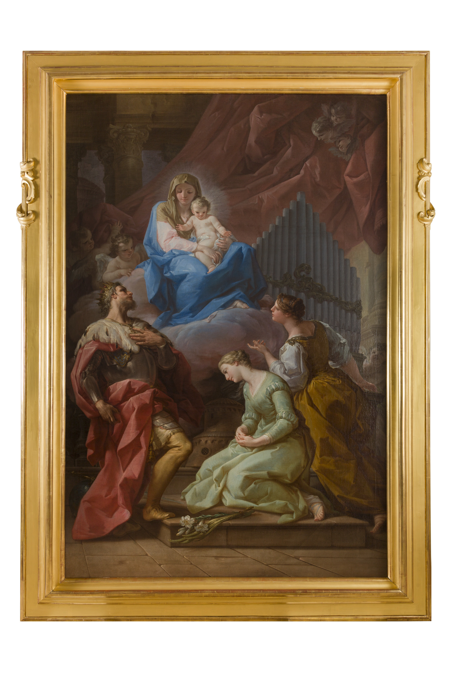
A similar project led him to paint a scene of the Baptism of Christ in the church of Santa Maria dell'Orto, a small parish church in Trastevere that had been decorated almost entirely by a series of artists of the Roman Mannerist school. At the same time, his intense activity led him to move for short periods to different locations in Italy. In Fermo, he was involved in the decoration of the Duomo, in Macerata, he decorated Palazzo Buonaccorsi and the Palazzo Ricci, while in Cesena, at the proposal of the jurist Francesco Chiaramonti, he was invited to paint the dome of the Capella della Madonna del Popolo. One of his masterpieces is the portrait of the castrato Farinelli, today held at the Bologna conservatory, although other important Italian cities also house works by the painter, such as the image of The Trinity in Perugia; the Vision of Saint Margaret of Cortona in Macerata; the Nativity of the Virgin in the Duomo of Pisa; the Transfer of the Relics of the Saints, now in Palermo; and another scene depicting the Nativity of the Immaculate Conception, now in a museum in the Sardinian capital. Molfetta, the village where Corrado Giaquinto was born, as well as a series of nearby locations such as Lecce, Taranto, Montefortino, Terlizzi and Bari, house a number of his religious works in various museums, diocesan seminaries and churches, although some are now in other European cultural institutions.
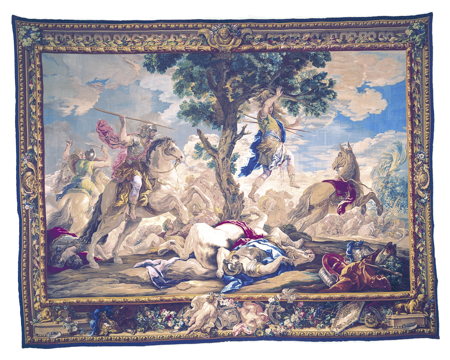
Ferdinand VI, then King of Spain, invited him to move to Madrid in 1753, probably to continue the works of Jacopo Amiconi, who had worked as a court painter and had taken over the direction of the Academy of San Fernando. On his arrival, Corrado Giaquinto was appointed director of this institution, an appointment that enabled him to train several generations of students, as well as supervisor of the Royal Tapestry Workshop in Madrid. This period was marked by feverish activity as in 1755, he supervised the decoration of the royal chapel in the Royal Palace, painted seven canvases for the Royal Site of Aranjuez, and executed several paintings on the life of Saint Francis de Sales and Jeanne de Chantal for the famous Salesian convent. He also executed the frescoes for the church vault and the dome at this site, although this commission was delayed until 1758. Greater interest has been displayed in Giaquinto’s works to decorate the Colonnaded Hall of the Royal Palace, where he painted the scene of The Birth of the Sun, and the staircase, where he painted a fresco on the theme of Spain Venerating Religion and the Church.
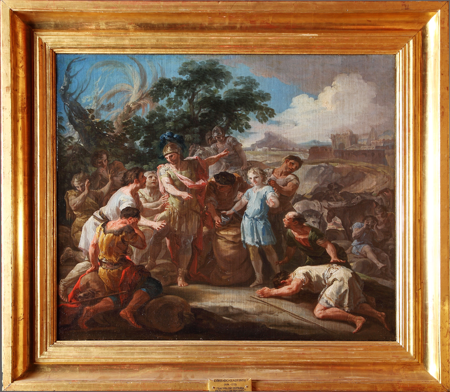
His beautiful sketches for the chapel dome of the Royal Palace, the staircase vault, and the set of paintings for the King's and Queen's oratories have thankfully remained intact. During this period, he worked closely with the architect Sacchetti as well as the sculptors in charge of the works on the new palace such as Olivieri, de Castro,or the painters González Velázquez and Castillo, who were responsible for various architectural and decorative designs. This period is also noteworthy for his easel paintings, although he achieved great fame as a painter of original religious and mythological scenes, as well as for his court portraits. In certain mythological works, he approached the subjects from a Rococo perspective, such as Venus and Adonis, the four allegories dedicated to Magnanimity, Peace, Liberty and Happiness, as well as The Birth of the Sun, Gideon and the Fleece, Circe, Aeneas and the Sibyl, and Hermes Slaying Argos. Similar interest has been paid to his portraits of saints such as Saint Ermengild, Saint Leander and Saint Isidore the Labourer. Less attention has been paid to his work as a restorer at the Buen Retiro palace, where he was responsible for restoring Luca Giordano’s The Order of the Golden Fleece. King Ferdinand VI and his wife Bárbara of Braganza, showered the artist with all kinds of distinctions and expressed their satisfaction with the brilliant results, although the accession of Charles III to the throne and above all, the arrival of Anton Raphael Mengs in Spain, hastened, to a certain extent, Giaquinto’s return to Italy. Art historians have noted that Giaquinto produced his most mature works during the nine years that he lived in Spain, as he could reinterpret the Baroque style in which he had been trained, adopting a new key to interpretation: delicate, sensual, spontaneous and, above all, very modern. In this regard, his poor health and the emergence of neoclassical art were responsible, to a certain extent, for putting an end to his career in Spain, frustrating his desire to turn the most important royal residences of the time such as the Buen Retiro Palace, the Royal Palace of Madrid and the Palace of Aranjuez into examples par excellence of the aesthetics of Rococo art.
Most of his Spanish artworks remain in the palaces for which they were painted, preserved by Patrimonio Nacional; in addition to the Prado Museum and the Capodimonte Museum in Naples. Other smaller institutions such as the Cerralbo Museum in Madrid and the Thyssen-Bornemisza Museum have recently displayed other works by the Italian artist in their collections. The Thyssen-Bornemisza Museum holds a rare work by Corrado Giaquinto, a small oil on copper of The Baptism of Christ, which critics believe is a preparatory sketch for the altarpiece he painted for the Roman church of Santa Maria dell'Orto.
The Cerralbo Museum has highlighted the possibility that a small work depicting The Resurrection of Christ may also have been executed by him.
His work in the royal palaces exerted a great influence on Spanish painters; indeed the works of Goya, Castillo, González Velázquez, Vicente López and Ramón Bayeu cannot be disassociated from the compositional models created by the Italian artist. Corrado Giaquinto's status as a master of masters has been highlighted in the recent exhibition “Corrado Giaquinto and Spain” organised by the art researcher and lecturer Alfonso Pérez Sánchez in Madrid. In 1762, he decided to return to Naples, having become a true master of the arts, which in turn had a positive effect on his oeuvre, and on the many young artists who sought to emulate his moderate classicism and formal elegance in painting. He spent his final years in his adopted city, Naples, until his death in 1766 due to a violent attack of apoplexy.
His place of burial is still unknown. International critics have highlighted his mastery in decorating interiors that were already the most famous in Europe, within his lifetime. His skill in producing frescoes and large paintings to embellish palatial halls and churches has also been praised, his recreations often appearing more akin to theatrical performances than static figures.
Source: Royal Academy of History (https://www.rah.es)