Use of Cookies

The Royal Collections Gallery uses its own and third-party cookies, mainly for technical purposes, which are necessary to provide our services and provide you with relevant content. More information in our cookies policy. Cookies Policy.

ACCEPT to confirm that you have read the information and accepted their installation. You can change your browser settings.

This exceptional loan from the Palace of Versailles is a perfect example of the familial and political ties that united the French and Spanish branches of the House of Bourbon, and it stands as a historical and artistic testament to the agreements and disagreements both branches of the family experienced throughout the 18th century.

Philip V’s (1863-1746) ambitions in Italy and the War of the Quadruple Alliance (1718–1720) had caused relations between the kingdoms of France and Spain to deteriorate.  In 1722, a double marriage was arranged to reconcile the two monarchies: Infanta Mariana Victoria (1718-1781) would wed her first cousin Louis XV (1710-1774), and Louis, Prince of Asturias and heir to the Spanish throne, would take one of the French regent’s daughters, Mademoiselle de Montpensier, as his wife. The princesses were exchanged on 10 December 1722 on Pheasant Island, a traditional meeting place for French and Spanish rulers, where ambassadors of both countries had previously handed over several royal fiancées: Elisabeth of France, the future wife of Philip IV; Anne of Austria, betrothed to Louis XIII; and Maria Theresa of Austria, who married Louis XIV.

Before her fourth birthday, Mariana Victoria was separated from her parents and sent to be raised at the Palace of Versailles, where she was treated like a little queen. However, the preadolescent Louis XV took absolutely no interest in his cousin, who was eight years younger. In fact, the marriage plans fell apart not long afterwards due to the death of the Spanish crown prince and the pressing need for Louis XV to produce an heir. Mariana Victoria was sent back to Spain on 5 April 1725, an insult that ended the reconciliation between the two countries and prompted Philip V to break ties with the land of his birth. 

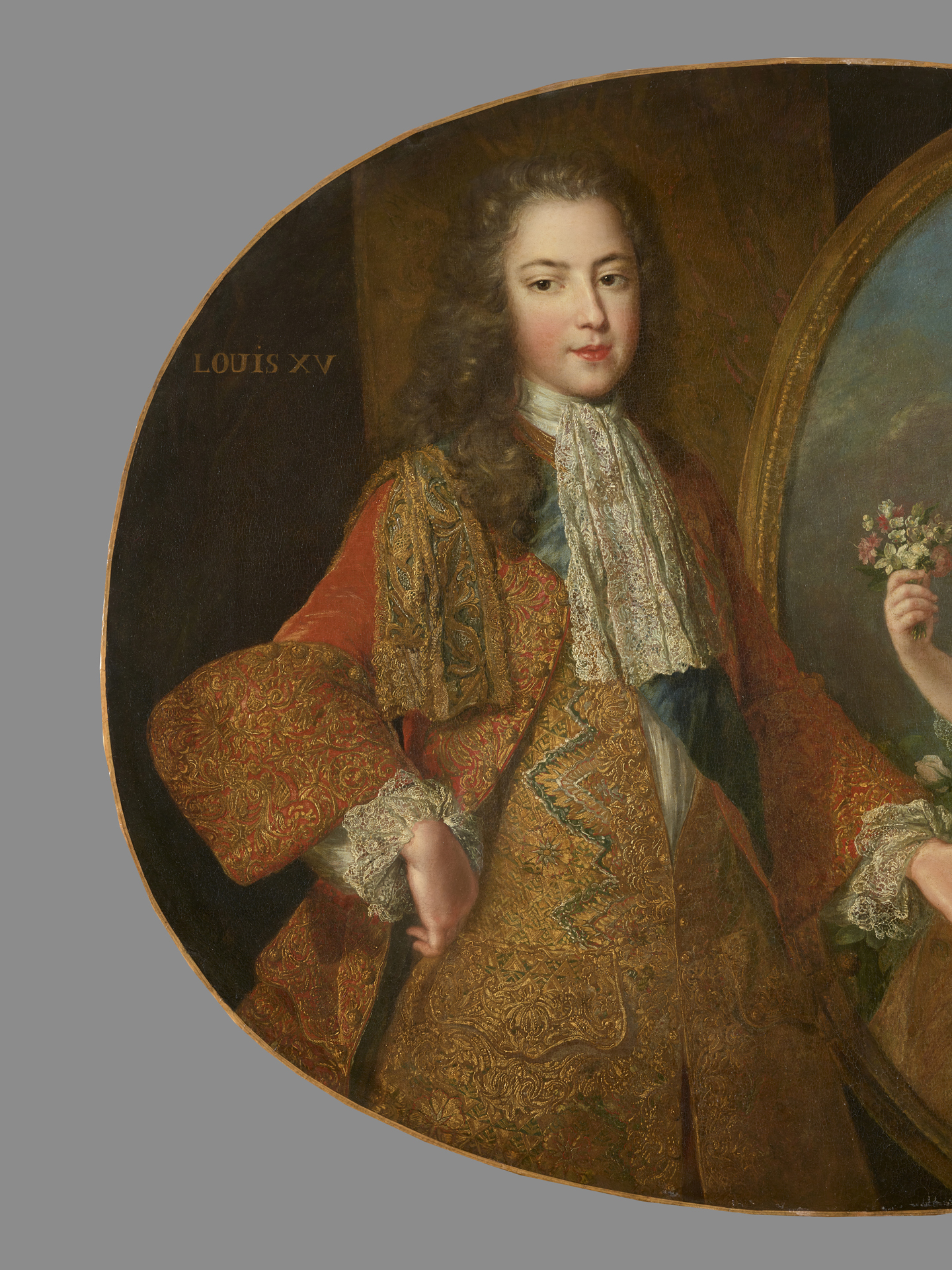
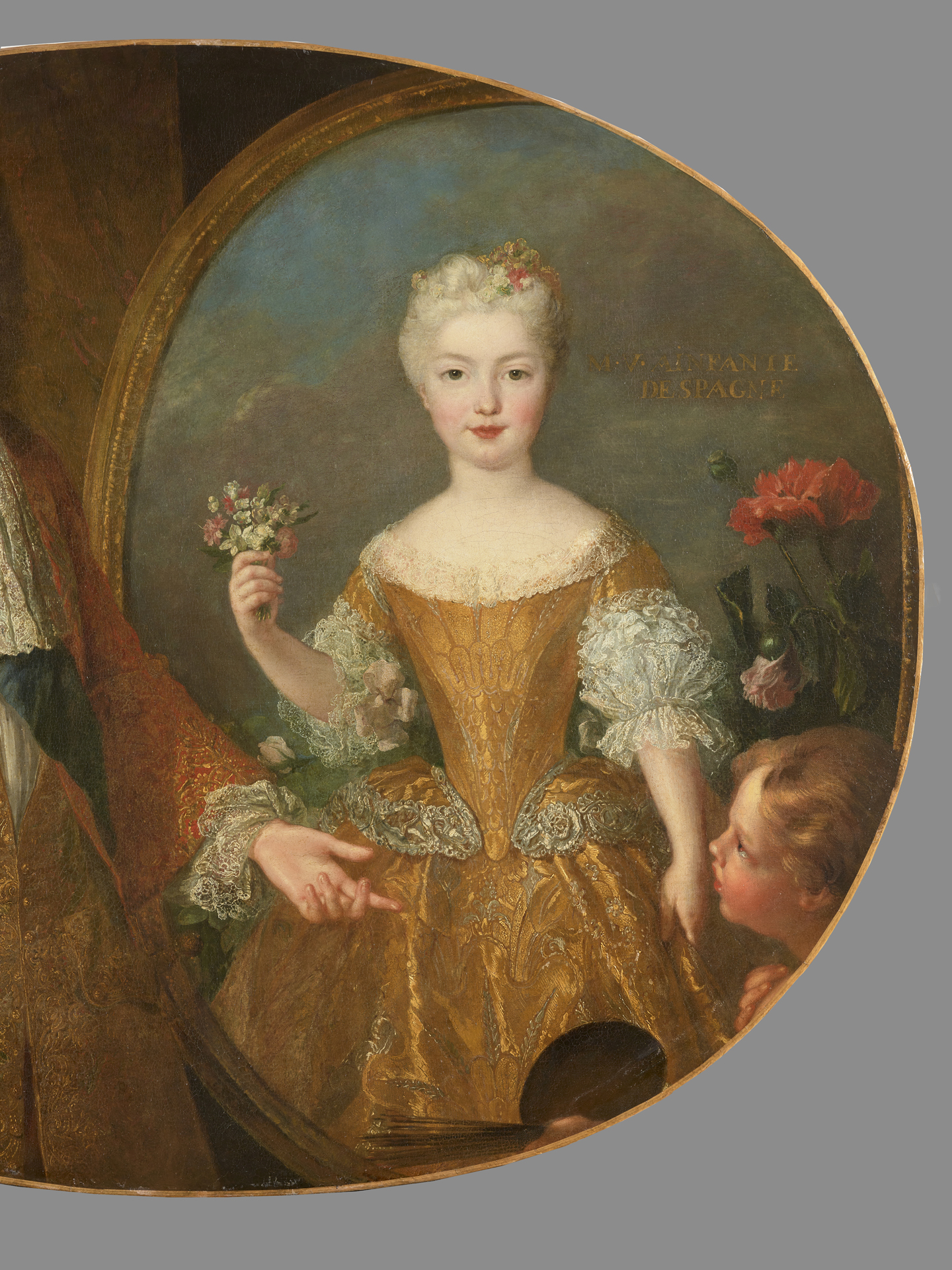
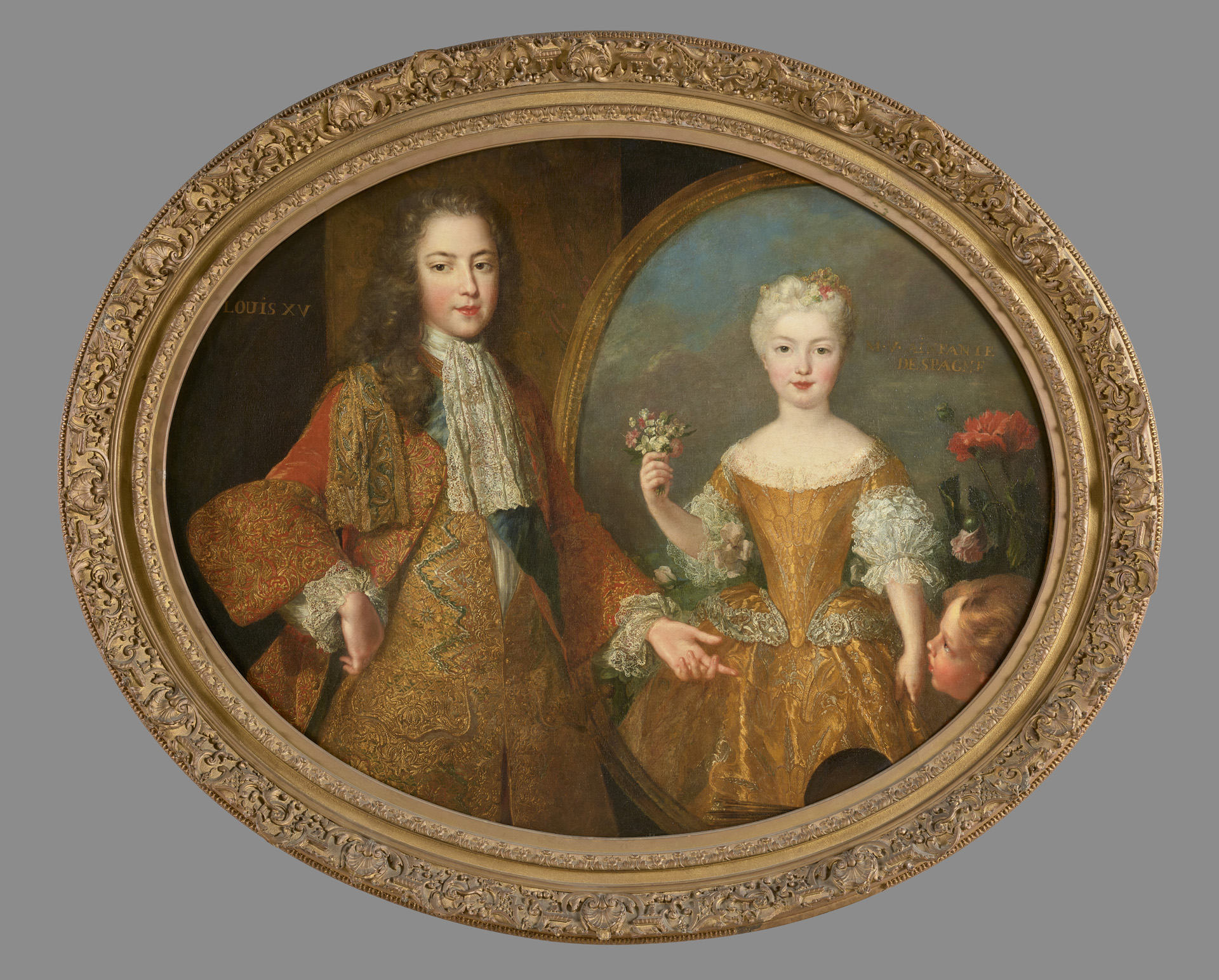
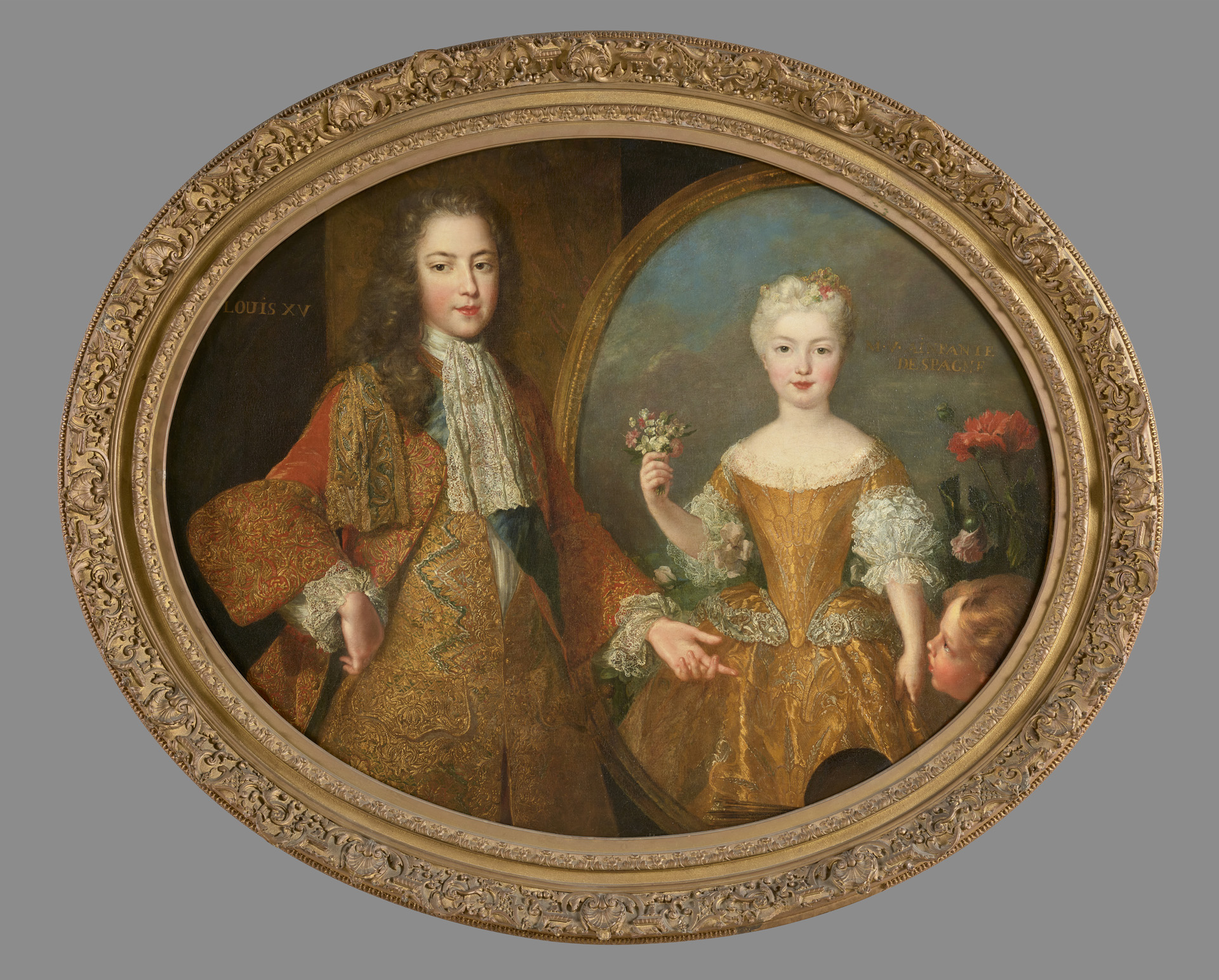
During her time at the French court, Mariana Victoria was portrayed on several occasions. This double portrait by Alexis Simon Belle, in which she is pictured with Louis XV, was painted shortly before her return to Spain. The little girl was seven at the time.

The son of a painter, Belle was introduced to the art of portraiture by his master, François de Troy (1645–1730), and became an expert in the genre; in fact, when he was admitted to the Académie royale de Peinture et de Sculpture in 1703, it was in the capacity of portrait painter. Belle received a large number of private commissions and rose to fame thanks to his portraits for the Polish court, the Stuarts (who had settled at Saint-Germain-en-Laye after James II was exiled from England) and, above all, the French royal family.

This composition uses the same royal double portrait formula that François de Troy had previously employed in a painting now at the Palazzo Pitti in Florence. As in his master’s work, Belle originally chose a vertical rectangular format that allowed him to depict the king standing in elegant court dress, with the blue sash of the Order of the Holy Spirit across his chest. The composition was cut into an oval shape at some unknown date and now focuses on the faces of the two subjects.

Rather than placing the infanta and the young king side by side, Belle opted for a mise en abyme: Mariana Victoria is pictured in a portrait to which Louis XV is elegantly drawing the viewer’s attention. This picture-within-a-picture is the work of Love, personified as a genius at the bottom right. 

This optical illusion allowed Alexis Simon Belle to downplay the age difference between the monarch and the princess. To reinforce the connection between his subjects, the painter also matched the colours of their luxurious garments and the decorative brocade and lace used to embellish them. Only two things show that Louis XV and his fiancée are not actually sharing the same space: the frame around the infanta’s fake portrait, and the contrasting backgrounds.

As a French court painter, Belle had previously done the portraits of Louis XV in his coronation robes (whose features he reused in this work) and of the young infanta in the gardens of Versailles.  Even though it is an official image of the royal couple, the delicate gestures, the youthful charm of the faces and Mariana Victoria’s endearing smile lend this court portrait a candour befitting the sitters’ tender years. 

Image gallery


French texts

Textes en français

Title

Love Presenting Louis XV with the Portrait of Infanta Mariana Victoria of Spain

Author

Alexis-Simon Belle (1674-1734)

Date

1724

Characteristics

Oil on canvas

Dimensions

127 x 154,5 x 11,5 cm.

Origin

National Museum of Versailles and Trianon

Location

Floor -2. Bourbons Hall

Credits

Text: Clara Terreaux, 18th Century Painting curator, Palace of Versailles. Fotography by: Christophe Fouin

Sponsors

Ramón Areces Foundation

Collaborators

National Museum of Versailles and Trianon

Other related works

Retrato de María Carolina Sobieska, princesa de Turenne y duquesa de Bouillon
Alexis-Simon Belle
1724
Palacio Real de La Granja de San Ildefonso
10002063

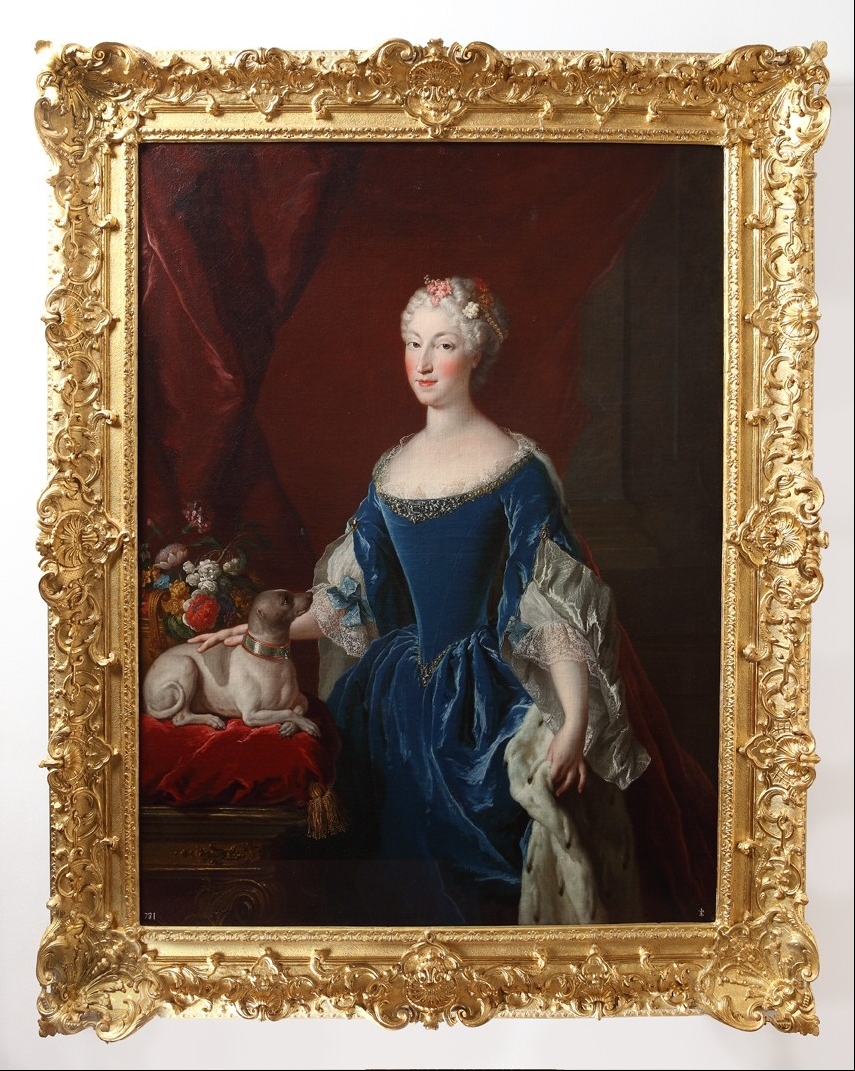
Retrato en tres cuartos de la princesa polaca María Carolina Sobieska (1697-1740), hija de Jacobo Luis Enrique Sobieski (1667-1737), príncipe heredero de Polonia, y de la condesa palatina Eduviges Isabel de Neoburgo (1673-1722), una de las muchas hermanas de Mariana de Neoburgo (1667-1740), segunda esposa de Carlos II (1661-1700) y tía de Isabel Farnesio (1692-1766), segunda esposa de Felipe V (1683-1746), de cuya colección de pinturas en San Ildefonso procede este retrato, marcado en el ángulo inferior derecho con la flor de lis blanca distintiva de la reina y, en el izquierdo, también en blanco, el número «731» del inventario de su colección en ese palacio real.
Por sus matrimonios sucesivos con los hermanos La Tour d’Auvergne, María Carolina fue princesa de Turenne y duquesa de Bouillon. En el retrato viste traje azul, encaje blanco en mangas y escote, y manto de terciopelo rojo que cae desde la espalda, cuyo forro de armiños toca con la mano izquierda. La derecha la apoya en un perro de compañía que está echado en una almohada de terciopelo rojo con borlas doradas sobre una mesa consola de talla dorada; en el collar metálico del animal se lee «·A·S·M· LA PRIN.SE / DE BOÜİLLON 1724». Detrás, un jarrón con flores. Lleva la princesa el cabello recogido, empolvado y adornado con flores blancas y rosas, que se recorta sobre el cortinaje rojo que sirve de fondo, en un interior con arquitectura.
Firmado y fechado en el reverso del lienzo: «A. S. Belle fecit 1724», lleva marco de madera tallada con decoración vegetal dorada, resaltada en los ángulos y medios.

Texto: Javier Jordán de Urríes de la Colina. Foto: Patrimonio Nacional

Authors and Collectors

Philip V
Monarch

Philip V

(Versalles (Francia), 1683 - Madrid, 1746)

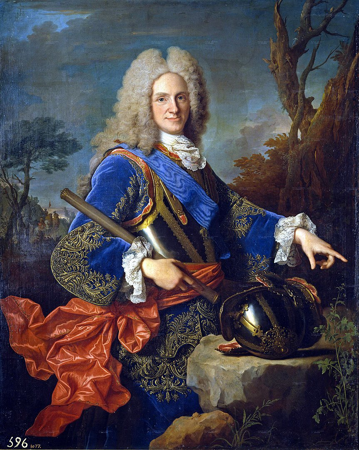
The second son of Louis of Bourbon (1661-1711), commonly known as the Grand Dauphin, heir to the French Crown, and Maria Anna Christine Victoria of Bavaria (1660-1690), the future Philip V grew up at the court of Versailles during the reign of his grandfather, Louis XIV of France. He was educated by François Fénelon, later Archbishop of Cambrai. Grandson of the Infanta Maria Theresa, eldest daughter of Philip IV, on his father’s side, he ascended the Spanish throne after the death of Charles II, who appointed him as his successor in his last will and testament dated 3rd October 1700. 

The first Spanish monarch of the House of Bourbon, Philip V's reign took place in two stages. The first lasted from November 1700 until 10th January 1724, when the monarch abdicated in favour of his eldest son, Louis I. The second stage was from 6th September 1724, when King Louis died of smallpox, until 9th July 1746, the date of his own death. 

Philip V was married twice. His first wife was Princess Maria Luisa Gabriella of Savoy (1688-1714), whom he married in Figueras (Gerona) on 3rd November 1701. The royal couple had four children: the future Louis I (1707-1724), who reigned briefly in 1724; the Infante Felipe (born and died in 1709); the Infante Philip Peter (1712-1719); and Ferdinand VI (1713-1759), who succeeded his father in 1746. After Queen Maria Luisa Gabriella of Savoy died on 14th February 1714, the King married Princess Elisabeth Farnese (1692-1766) of Parma, in Guadalajara on 24th December that same year. The couple had seven more children: the future Charles III of Spain (1716-1788); the Infante Francisco (born and died in 1717); the Infanta Mariana Victoria (1718-1781), Queen of Portugal by marriage to Joseph I (1714-1777); the Infante Philip (1720-1765), Duke of Parma; the Infanta Marie Thérèse (1726-1746), Dauphine of France by marriage to Louis, Dauphin of France (1729-1765); the Infante Luis Antonio (1727-1785), who was to become Archbishop of Toledo and Cardinal of the Holy See; and the Infanta Maria Antonia Ferdinanda (1729-1785), Queen of Sardinia by her marriage to Victor Amadeus III of Savoy (1726-1796).

The early years of Philip V's reign were marked by the outbreak of the War of the Spanish Succession (1701-1714), which pitted France and the Hispanic Monarchy against the powers of the Grand Alliance of The Hague: England, the Dutch Republic and the Holy Roman Empire, joined by Portugal and Savoy in 1703. Although the origins of the conflict lay in Leopold I's defence of the succession rights of his son, Archduke Charles of Austria, it was also influenced by political, economic and commercial factors. In Spain, the War of the Spanish Succession also resulted in a civil conflict. While there was widespread loyalty to Philip V amongst Castilians, Navarrese and the Basque, large sectors of society in Valencia, Aragón, the Balearic Islands and Catalonia, known as "Habsburgists", were in favour of Archduke Charles, who established his court in Barcelona in 1705. 

Throughout 1713, all European powers, with the sole exception of Austria until 1725, recognised Philip V as King of Spain. However, under the Peace Treaty of Utrecht-Rastatt (1713-1714), the Hispanic Monarchy had to relinquish the Netherlands and its territories in Italy, as well as Gibraltar and Minorca to England, which also received certain trade privileges overseas. The end of the War of the Spanish Succession also meant the entry into force of the Nueva Planta Decrees in Valencia, Aragón, Mallorca and Catalonia. These decrees were enacted between 1707 and 1716 and proposed a complete overhauling of the prevailing political and administrative systems of the Hispanic Monarchy up to that time.  

Post-1714, Spain’s foreign policy was dictated by the revisionism of the Treaties of Utrecht-Rastatt and by the Spanish government's interest in reconquering Minorca, Gibraltar and the Italian territories ceded after the peace. This prompted the signing of the first and second "Family Pact” on 7th November 1733 and 25th October 1743 respectively with France, as well as Spain's intervention in the Wars of the Polish Succession (1733-1735) and the Austrian Succession (1740-1748). Although it could not recover Minorca and Gibraltar, Spain managed to conquer the Kingdoms of Naples and Sicily, as well as the Duchy of Parma, granted to the King's sons, the Infantes Charles, the future Charles III, and Philip of Bourbon. Prior to this, the Spanish government had re-established relations with the Holy See by signing the Concordats of 1717 and 1737. 

In terms of domestic policy, Philip V's reign was characterised by reform and administrative rationalisation, driven by the creation of the Secretaries of State and of the Office. Initially, foreigners such as the Frenchman Jean de Orry, the Parmese Cardinal Alberoni, and the Dutch Juan Guillermo Ripperdá shared power with ministers of Spanish origin such as José Grimaldo and Melchor de Macanaz. However, from the late 1720s onwards, the technocrats José Patiño and José del Campillo would become the most influential figures in the government. Improvements in tax administration, the introduction of intendants, restructuring the army and navy, stimulating the development of industry, establishing the Royal Manufacturers and chartered trading companies, and moving the House of Trade of the Indies from Seville to Cadiz (1717) were some measures adopted by Philip V's ministers after the War of the Spanish Succession. 


Within the cultural sphere, notable achievements include the foundation of the Royal Library in 1711, the precursor to the current National Library of Spain; the Royal Academies of Spanish and History in 1714 and 1738 respectively; the University of Cervera in 1717, and other scientific institutions such as the Royal College of Surgeons of Cadiz, for example. A lover of the fine arts, Philip V was also a patron of the Neapolitan singer Carlo Broschi, known as Farinelli, and the painters Miguel Jacinto Meléndez, Jean Ranc and Louis-Michel van Loo, among others. He was also responsible for the building of the Palace of La Granja de San Ildefonso (Segovia) and the Royal Palace of Madrid. 


The King died in Madrid on 9th July 1746. His remains are buried alongside those of his second wife, Elisabeth Farnese, in the crypt of the Royal Collegiate Church of the Holy Trinity in the Palace of La Granja de San Ildefonso. 

Source: Royal Academy of History (https://www.rah.es)

Read more
Elisabeth Farnese
Monarch

Elisabeth Farnese

(Parma (Italia), 1692 - Aranjuez (Madrid), 1766)

Daughter of Odoardo Farnese (1666-1693), Prince of Parma, and Dorothea Sophie of Neuburg (1670-1748), sister of Maria Anna of Neuburg (1667-1740), second wife of Charles II of Spain (1661-1700), Elisabeth Farnese’s upbringing was supervised by her mother, who saw to it that she received a solid artistic and cultural education. Betrothed to the King of Spain in 1714, at the urging of the diplomat Jules Alberoni, of Parma, and the Princesse des Ursins, the chief chambermaid and confidante of the King's first wife, Maria Luisa Gabriella of Savoy (1688-1714), her marriage to Philip V (1683-1746) was celebrated in Guadalajara on 24th December 1714. A woman with a strong personality, one of her first measures was to banish the influential Princesse des Ursins, the person responsible for her marriage.

The King and Queen formed a well-matched couple who had seven children: the future Charles III of Spain (1716-1788); the Infante Francisco (born and died in 1717); the Infanta Mariana Victoria (1718-1781), Queen of Portugal by marriage to Joseph I (1714-1777); the Infante Philip (1720-1765), Duke of Parma; the Infanta Marie Thérèse (1726-1746), Dauphine of France by marriage to Louis Ferdinand of Bourbon, Dauphin of France (1729-1765); the Infante Luis Antonio (1727-1785), who was to become Archbishop of Toledo and Cardinal of the Holy See; and the Infanta Maria Antonia Ferdinanda (1729-1785), Queen of Sardinia by her marriage to Victor Amadeus III of Savoy (1726-1796). 

As Queen, Elisabeth Farnese exercised considerable political influence and protected the careers of ministers such as the Cardinal Alberoni, Juan Guillermo Ripperdá, José Patiño and the Marquess of Villadarias. Moreover, when Philip V was ill, the Queen personally, albeit unofficially, took over the management of state affairs.

After her husband's death on 9th July 1746, Elisabeth Farnese was forced by her stepson, Ferdinand VI, to retire to the Palace of La Granja de San Ildefonso (Segovia). During the thirteen years of her retirement, the Queen concentrated on her cultural interests, such as expanding her art collection, and the construction of the Palace of Riofrío (Segovia). After Ferdinand VI died without heirs on 10th August 1759, Elisabeth Farnese served as interim Governor while her eldest son, the new King Charles III, travelled to Spain. 

The Queen died at Aranjuez Palace on 11th July 1766. Her remains lie alongside those of Philip V in the crypt of the Royal Collegiate Church of the Holy Trinity in the Palace of La Granja de San Ildefonso (Segovia). 

Source: Royal Academy of History (https://www.rah.es)
Read more
Louis I of Spain
Monarch

Louis I of Spain

(Madrid, 1707 - Madrid, 1724)

The eldest son of Philip V (1683-1746) and his first wife, Maria Luisa Gabriella of Savoy (1688-1714), Louis I was the first Bourbon monarch to be born in Spain. His birth was hailed with joy by the people, who had not witnessed the birth of an heir to the Crown for forty-six years. Christened Louis Ferdinand, his godparents were his great-grandfather, King Louis XIV of France, and his aunt, the Duchess of Orléans. Prince Louis' childhood coincided in part with the War of the Spanish Succession (1701-1714). On 7th April 1709, when he was not yet two years old, he was sworn in as Prince of Asturias at the Church of San Jerónimo El Real in Madrid. His early years were spent in the company of his mother, Queen Maria Luisa Gabriella of Savoy, his governess, the Princesse des Ursins, also the Queen's chief chambermaid, and the assistant governess, Maria Antonia de Salcedo y Chávarri, the future Marchioness of Montehermoso. After the death of Queen Maria Luisa Gabriella of Savoy, whereupon Philip V married Elisabeth Farnese (1692-1766) and exiled the Princesse des Ursins in 1714, the second stage of the Prince’s training began. The appointment of Cardinal del Giudice as the Prince's caretaker, followed later by the Duke of Popoli with the Marquess of Surco as assistant caretaker, and of the Jesuit priest Ignace de Laubrussel as tutor, not only formed a predominantly male circle around the heir but also ushered in a more rigorous and formal education in which courtly training and protocol carried considerable weight. 


Negotiations for the marriage of Prince Louis commenced in 1721, within the context of a new diplomatic rapprochement between the French and Spanish courts. The Prince's bride was Louise Élisabeth d'Orléans (1709-1742), daughter of Philippe II, Duke of Orléans, then Regent of France during Louis XV's minority. The Prince and Princess of Asturias were married in the town of Lerma on 20th January 1722. On the occasion of their marriage, the first Prince's Household was established, a new step in his entry into adult life. By then, Prince Louis was described as a young man fond of hunting and riding, skilled in dancing and the sports of the time such as pall-mall, and given to hobnobbing with the sons of the palace servants, who were of a similar age as him. He was on good terms with his brothers, the Infante Philip, who died in 1719, and the future Ferdinand VI, as well as, contrary to what has sometimes been claimed, with his half-brothers, the Infante Charles, later Charles III, and the Infanta Mariana Victoria. The Prince was on equally good terms with his stepmother, Queen Elisabeth Farnese, who always treated him with the consideration due to his status as heir to the Crown. 


Following the abdication of his father Philip V, Louis I became King of Spain on 10th January 1724. Given that the monarch had not yet reached the age of seventeen when he ascended the throne, Philip V ordered the creation of a Government Council to advise the new King in the exercise of his power. Consisting of the presidents of various Councils of the Kingdom who were loyal to the former monarch, the Government Council allowed Philip V to control his son’s actions regarding affairs of state from the Palace of La Granja de San Ildefonso (Segovia). 


He was highly popular among his subjects, giving rise to the name of Well-Beloved. However, Louis I barely had any time to reign. Although a power group called the "Spanish party" had begun to form around the King, seeking to neutralise the pro-French policy hitherto pursued by Philip V, the influence of its members on the monarch was halted in the summer of 1724, when Louis I fell ill with smallpox. Despite the care he received from royal physicians and his wife, Queen Louise Élisabeth d'Orléans, the monarch died in Madrid on 31st August of the same year. The remains of Louis I are buried in the Pantheon of Kings and Queens in the Monastery of El Escorial. At the end of what became known as the "lightning reign” for its brevity, Philip V left the Palace of La Granja and was restored to the Spanish throne after consulting the Council of Castile and a Board of theologians. 

Source: Royal Academy of History (https://www.rah.es)
Read more

Media