
Use of Cookies

The Royal Collections Gallery uses its own and third-party cookies, mainly for technical purposes, which are necessary to provide our services and provide you with relevant content. More information in our cookies policy. Cookies Policy.

ACCEPT to confirm that you have read the information and accepted their installation. You can change your browser settings.

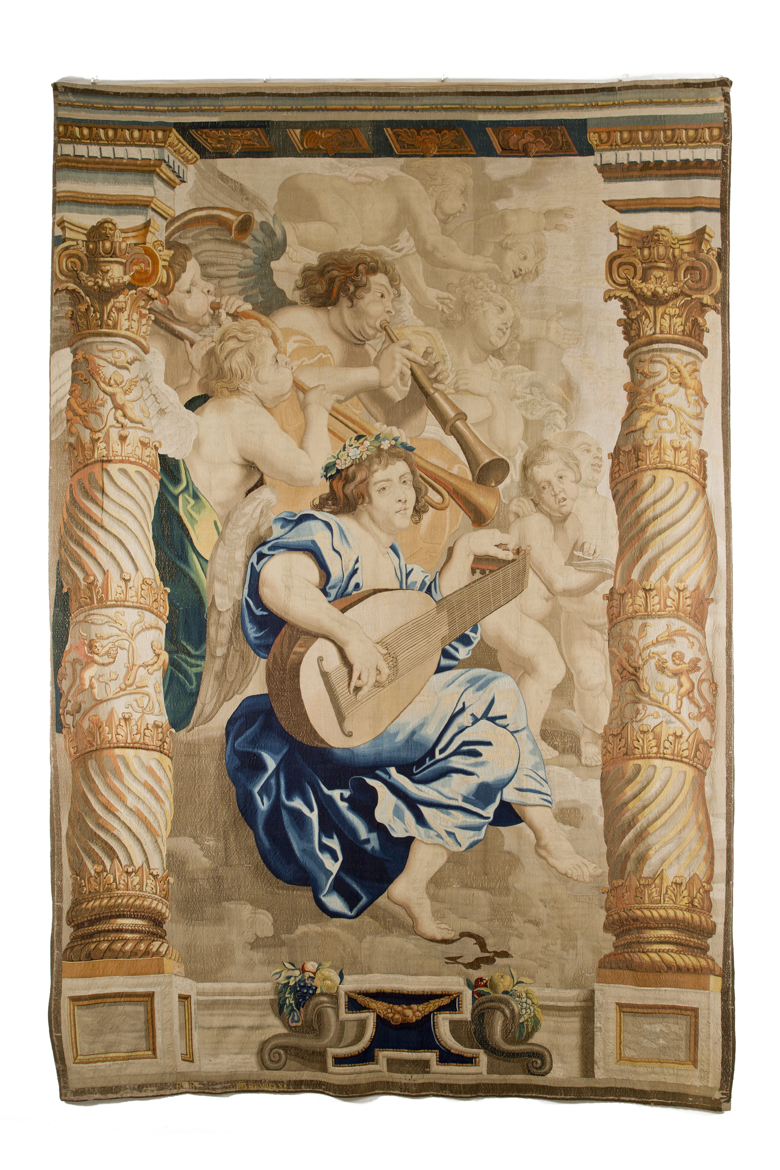
Ángeles músicos

Tapiz: Jacob Geubels II; Diseño: Rubens, Pedro Pablo
1625-1633

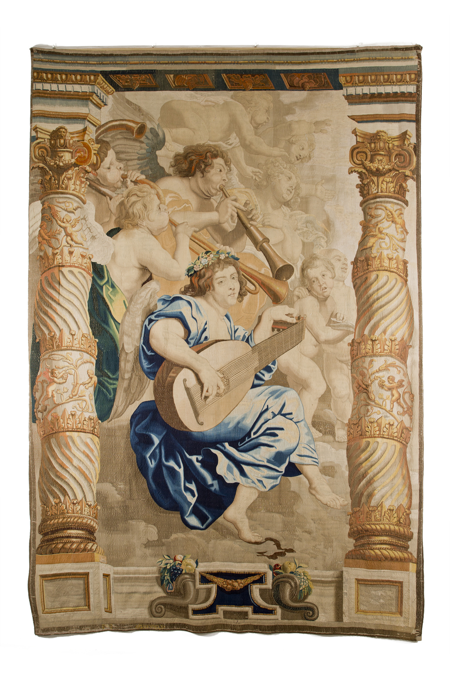
Enmarcados por dos columnas salomónicas aparecen nueve ángeles distribuidos en varios grupos. En un primer plano, y ocupando la mayor parte de la escena, destaca un ángel vestido de azul y con una corona de flores que le ciñe la cabeza. Mira al espectador al tiempo que parece manipular las clavijas para afinar el laúd. Tras él, tres ángeles tocan instrumentos de viento: el más cercano al espectador toca un sacabuche, que en su época se consideró el instrumento de boquilla más perfecto y evolucionado; en un segundo plano, otro ángel toca el serpentón, instrumento inventado a finales del siglo XVI y que se utilizaba para acompañar a los coros en los oficios religiosos; y, al fondo, un tercer ángel toca la chirimía, instrumento de madera utilizado desde la Edad Media y que en el Renacimiento era imprescindible en las capillas musicales de las iglesias.

En la parte derecha de la escena, dos pequeños ángeles desnudos se encuentran de pie mientras cantan siguiendo un cantoral. Tres ángeles más ocupan la parte alta de la escena, en una actitud de alabanza. El tratamiento de estos últimos, al igual que los pequeños cantores, recuerda a las grisallas, ya que aparecen tejidos utilizando una gama de tonos del mismo color.

Este paño forma parte de un grupo de cinco tapices que fueron concebidos por Rubens para decorar la pared sur de la iglesia del Monasterio de las Descalzas Reales. Ocupaba la parte superior izquierda de la composición y hace pareja con otro similar (nº inv. 00614218).

General Classification

Textiles

Type of Object

Tapiz

By

Tapiz: Jacob Geubels II; Diseño: Rubens, Pedro Pablo

Title

Ángeles músicos

Collection or Series Title

El triunfo de la Eucaristía

Era / Cultural Context

Reinado de Felipe IV; Barroco

Place of Production

Bruselas

Date

1625-1633

Subject

Lana; Seda

Technical

Tapiz

Dimensions

Fondo completo (Altura: 507,5 centímetros; Anchura: 333,5 centímetros)

Inventory

00614224

Credits

Texto: Ana García Sanz; Foto: Francisco Jaén

Authors and Collectors

Rubens, Peter Paul
The Author

Rubens, Peter Paul

(Siegen (Germany), 1577 - Antwerp (Netherlands), 1640)

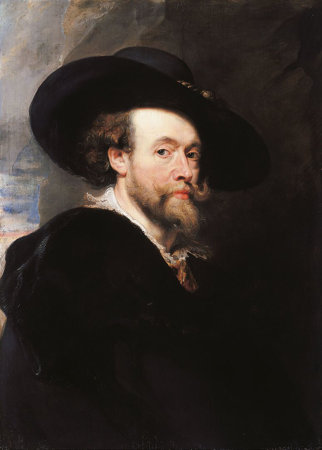
Peter Paul Rubens (Siegen, Holy Roman Empire, present-day Germany, 28th June 1577 - Antwerp, Duchy of Brabant, Habsburg Netherlands, present-day Belgium, 30th May 1640), also known as Peter Paul Rubens, Pieter Paul, Pieter Pauwel or Petrus Paulus, was a Flemish Baroque painter. His exuberant style emphasised dynamism, colour and sensuality. His main influences were Ancient Greek and Roman art and the Italian Renaissance painters, especially Leonardo da Vinci; Michelangelo, whose depiction of anatomy he admired; and above all Titian, whom he considered his master and of whom he stated that "with him, painting has found its essence".

He painted a wide variety of subjects: religious and historical scenes, classical mythology, hunting scenes, landscapes, portraits, as well as drawings, illustrations for...
Read more
Philip IV
Monarch

Philip IV

(Valladolid, 1605 - Madrid, 1665)

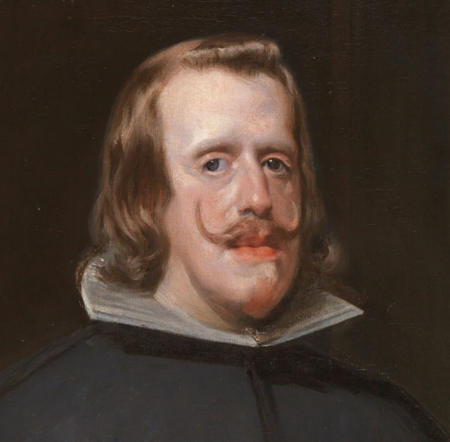
The third son of Philip III (1578-1621) and Margaret of Austria (1584-1611), the future Philip IV was born in Valladolid, the capital of the Hispanic Monarchy between 1601 and 1606. Sworn heir to the Crown on 30th January 1608, in the Church of San Jerónimo El Real in Madrid, he was educated by Galcerán Albanell, a Catalan nobleman of renowned erudition. Prince Philip, as he was then, received classes in History, Geography, Mathematics and military tactics. After ascending the throne in 1621, he furthered his education by expanding his reading and learned languages such as Italian and French. 


Philip IV was married twice. His first wife was Elisabeth of France (1602-1644) whom he married on 18th October 1615 and...

Read more

The work in context

View in Timeline