Loading...

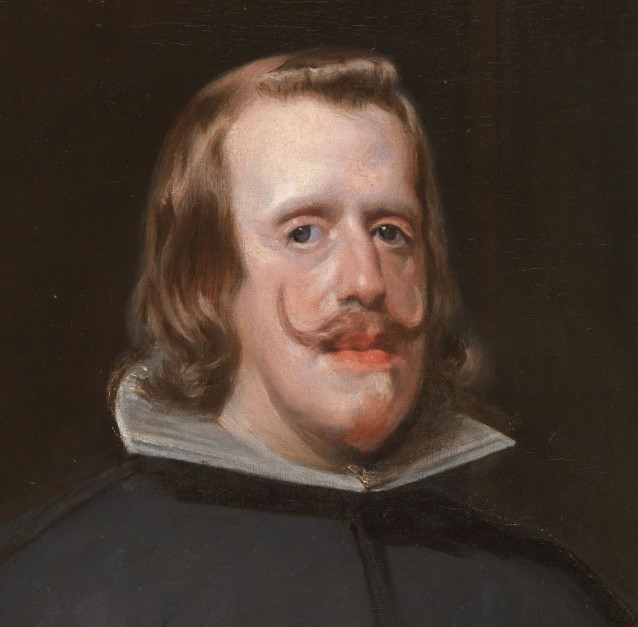
Casa de los Austrias
Philip IV
Valladolid, 08 de April de 1605 - Madrid, 17 de September de 1665
View in TimelineBiography
The third son of Philip III (1578-1621) and Margaret of Austria (1584-1611), the future Philip IV was born in Valladolid, the capital of the Hispanic Monarchy between 1601 and 1606. Sworn heir to the Crown on 30th January 1608, in the Church of San Jerónimo El Real in Madrid, he was educated by Galcerán Albanell, a Catalan nobleman of renowned erudition. Prince Philip, as he was then, received classes in History, Geography, Mathematics and military tactics. After ascending the throne in 1621, he furthered his education by expanding his reading and learned languages such as Italian and French.
Philip IV was married twice. His first wife was Elisabeth of France (1602-1644) whom he married on 18th October 1615 and with whom he had eight children: Infanta María Margarita (born and died in 1621); the Infanta Margarita María (born and died in 1623); the Infanta María Eugenia (1625-1627); the Infanta Isabel (born and died in 1627); Prince Balthasar Charles (1627-1646), heir to the Spanish Crown until his death a few days before his seventeenth birthday; the Infanta María Antonia (1635-1636); and the Infanta Maria Theresa (1638-1683), Queen of France by her marriage to Louis XIV (1638-1715). After the death of Elisabeth of France in October 1644, Philip IV married his niece, the Archduchess Maria Anna of Austria (1634-1696), on 7th October 1649. The royal couple had five children: the Infanta Margaret Theresa (1651-1673), Holy Roman Empress by marriage to Leopold I (1640-1705); the Infanta Maria Ambrosia (born and died in 1655); Prince Felipe Prospero (1657-1661); the Infante Fernando Tomás (1658-1659) and the future King Charles II (1661-1700), who succeeded his father on the throne. The King also had several natural children. The best known of them all, born of his extramarital affair with the theatre actress María Calderón, also called La Calderona, was John Joseph of Austria (1629-1679).
Philip IV became King of Spain after the death of Philip III on 31st March 1621. When he ascended the throne, he had little knowledge of governance. For this reason, from 1622 onwards, the Count-Duke of Olivares enjoyed an ever-increasing influence over the affairs of state. As the favourite of Philip IV, the Count-Duke sought to develop a reformist policy capable of boosting the economic development of Castile and alleviating the Royal Treasury’s debt. However, his most ambitious plan was the “Union of Arms” project of 1624, whereby the Count-Duke sought to encourage military collaboration between the different territories of the Hispanic Monarchy, the first step towards greater administrative, institutional and legal integration between them. The plan of the Count-Duke of Olivares was not well received in Portugal, Aragón, Catalonia and Valencia, and obtained mixed results.
In the sphere of international relations, with Philip IV’s approval, he abandoned the policy of armed neutrality that had characterised the reign of Philip III and pushed for the implementation of a prestigious foreign policy. The goals of the Count-Duke entailed increased involvement of the Hispanic Monarchy in the Thirty Years' War, the resumption of hostilities with the United Provinces in 1621, year in which the Twelve Years' Truce ended, and the confrontation with France from 1635 onwards. None of these conflicts would end well for the Hispanic Monarchy. The Peace of Westphalia (1648) forced the government in Madrid to recognise the independence of the United Provinces and ended what was left of Spanish hegemony in Europe, while the Treaty of the Pyrenees (1660) resulted in Spain ceding territory to France: the county of Artois, Roussillon and part of Cerdagne.
The economic, human and financial cost of Spain's active foreign policy in this period in turn influenced the outbreak of the Crisis of 1640, which led to the secession of Portugal in the same year, the Catalan rebellion between 1640 and 1652, and instability in other parts of the Monarchy such as Andalusia and Spanish Italy. As a result of these events, at the end of January 1643, the Count-Duke of Olivares was dismissed from all court offices and posts by the King. His successors Luis de Haro, the Count of Castrillo and the Duke of Medina de las Torres, though trusted by the King, lacked the influence and political projection that the Count-Duke had enjoyed in his day.
Finally, it should be noted that Philip IV’s reign coincided with the period of the greatest Baroque splendour in Spain. Fond of the theatre and arts, the King sponsored the careers of some of the most outstanding playwrights, writers and artists of the "Golden Age". Lope de Vega, Quevedo, Calderón de la Barca or the painters Fray Juan Bautista Maíno, Vicente Carducho and Diego Velázquez, amongst others, benefited from the monarch’s patronage. Additionally, during the 1630s, at the behest of the Count-Duke of Olivares, the Buen Retiro Palace was built as a second residence for the King and Queen in Madrid.
Philip IV, also called the Planet King, died in Madrid on 17th September 1665. His remains are buried in the Pantheon of Kings and Queens in the Monastery of El Escorial, whose decoration was also at the King’s initiative.
Source: Royal Academy of History (https://www.rah.es)