Use of Cookies

The Royal Collections Gallery uses its own and third-party cookies, mainly for technical purposes, which are necessary to provide our services and provide you with relevant content. More information in our cookies policy. Cookies Policy.

ACCEPT to confirm that you have read the information and accepted their installation. You can change your browser settings.

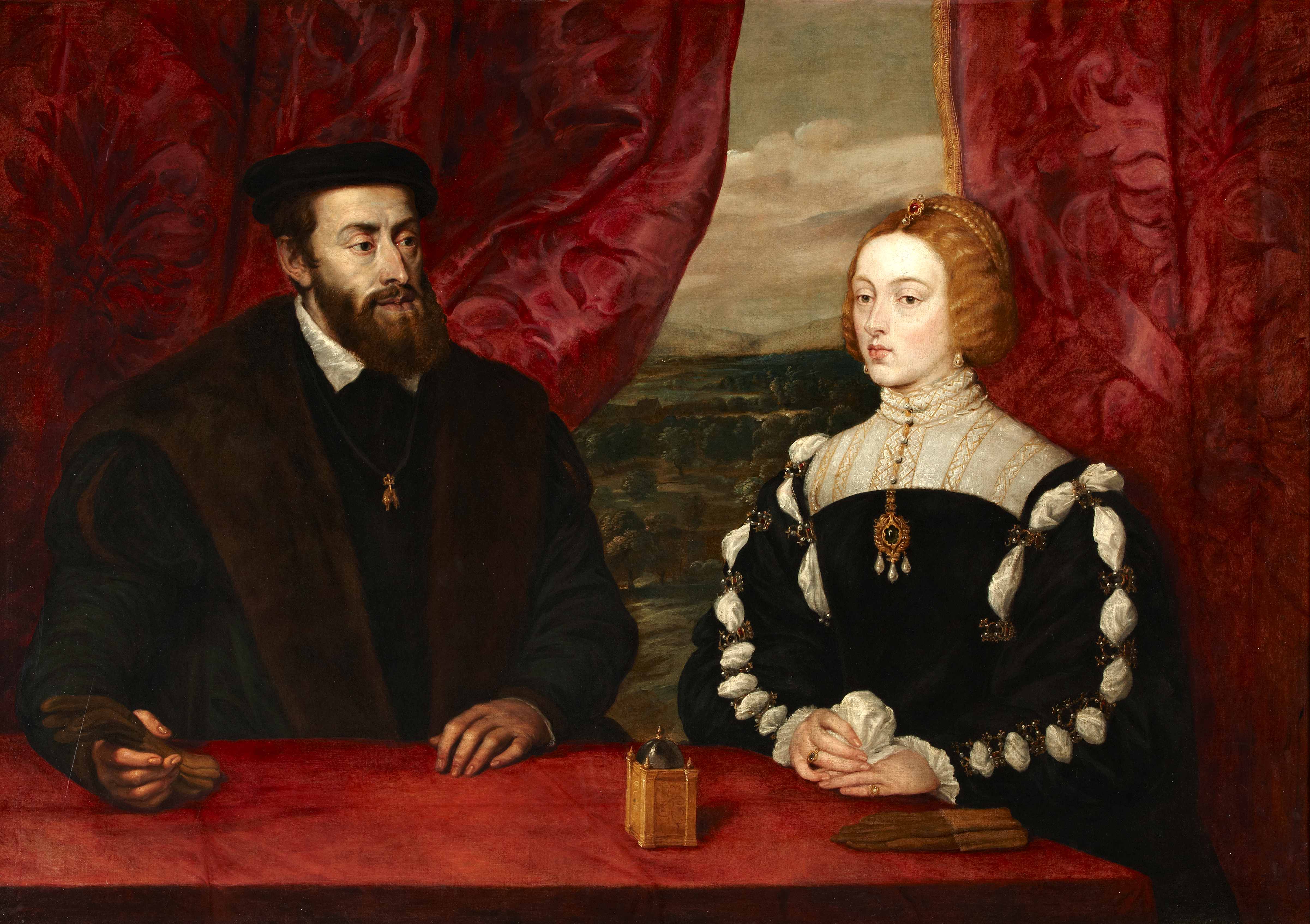
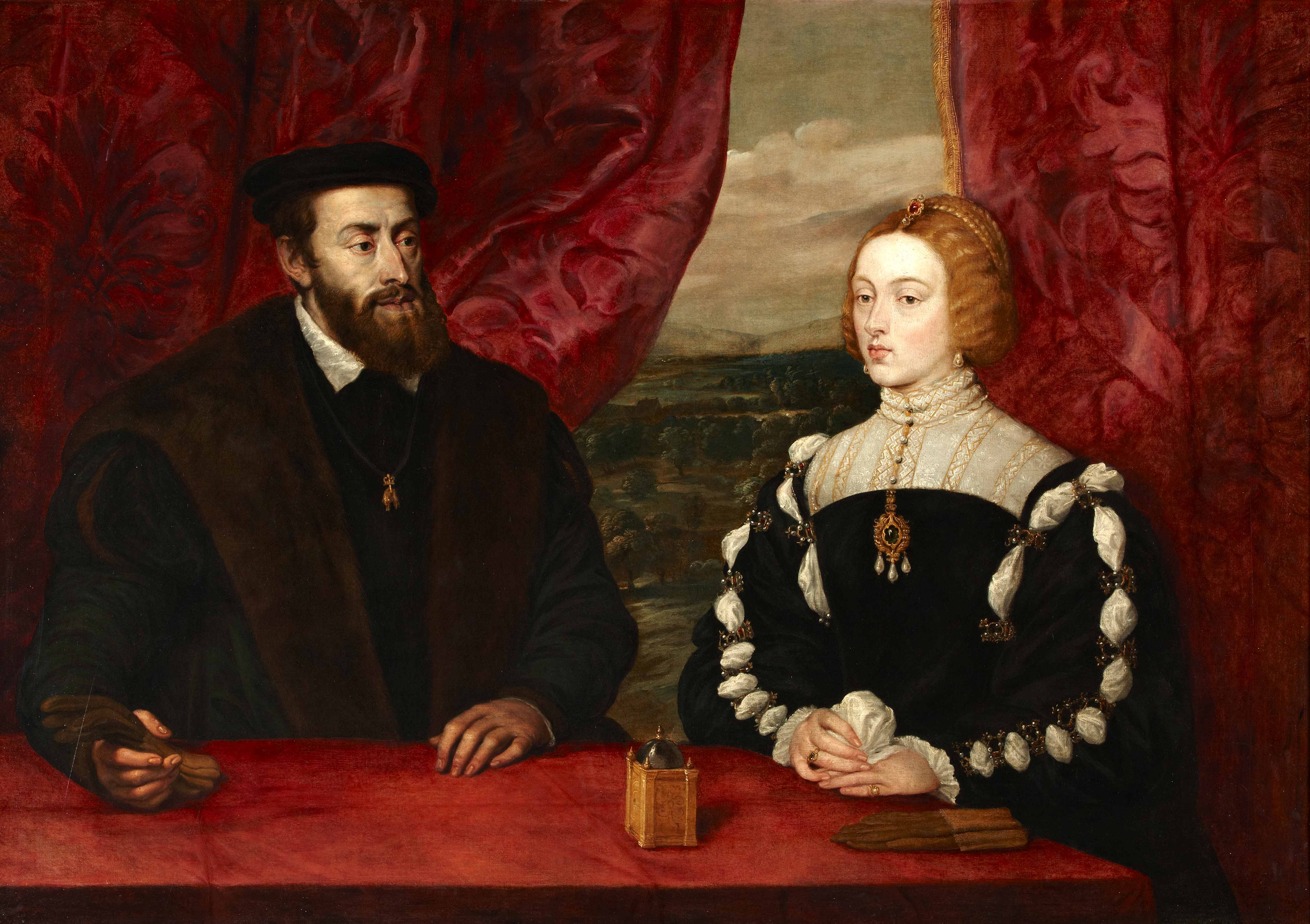
The Emperor Charles V and Empress Isabella of Portugal is one of the most remarkable works in the Liria Palace. It was acquired in London in 1936 by the 17th Duke of Alba, Jacobo Fitz-James Stuart y Falcó (1878-1953), and has remained in the Alba collection since that date. In the present day the painting is displayed in the Flemish Room of the Liria Palace.

Duke of Alba

The 17th duke was one of the most significant figures in the history of the family. He was known for his love of history, inherited from his mother, Rosario Falcó (1854-1904), and enthusiastically participated in many of the cultural initiatives undertaken in Spain during the first half of the 20th century. Jacobo Fitz-James Stuart was a member of the three major Spanish academies and served as director of the Royal Academy of History for more than twenty-five years. He also promoted the creation of various cultural institutions, becoming chairman of the Board of Trustees of the Museo del Prado. He significantly expanded the ducal collection through the acquisition of outstanding works by great masters, associated with both his family's history and the history of Spain.

The commission for Titian

This splendid version by Peter Paul Rubens (1577-1640) is the only surviving record of the original work by Titian (1490-1576), which was lost in the fire at the Alcázar in Madrid in 1734.
In 1548, during the Diet of Augsburg, Titian received a commission from Charles V (1500-1558) to paint a series of portraits of the imperial family. In addition to the celebrated portrait of Charles V on horseback at Mühlberg, now in the Museo Nacional del Prado, it was at this moment that he executed a double portrait of the emperor and Isabella of Portugal (1503-1539).
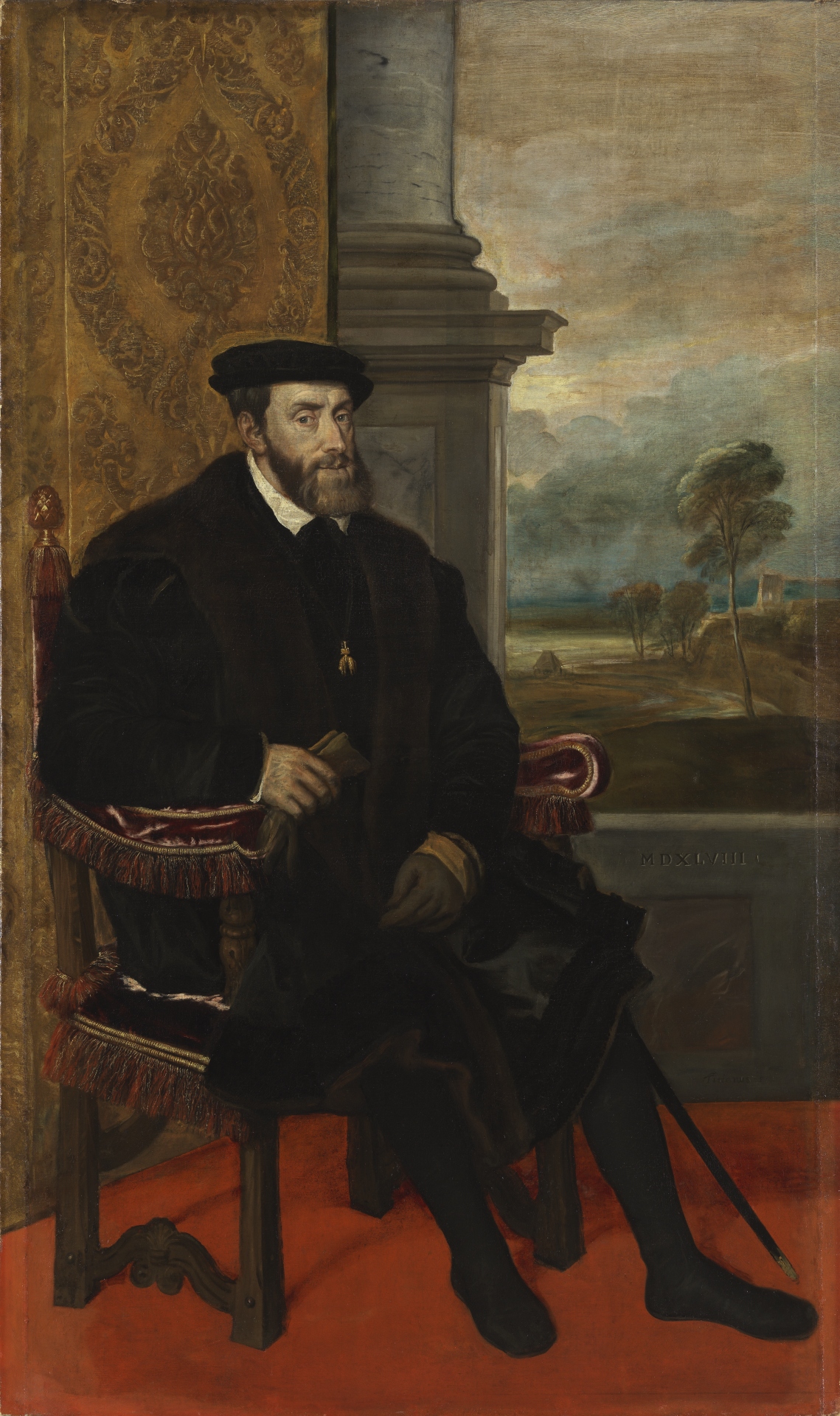
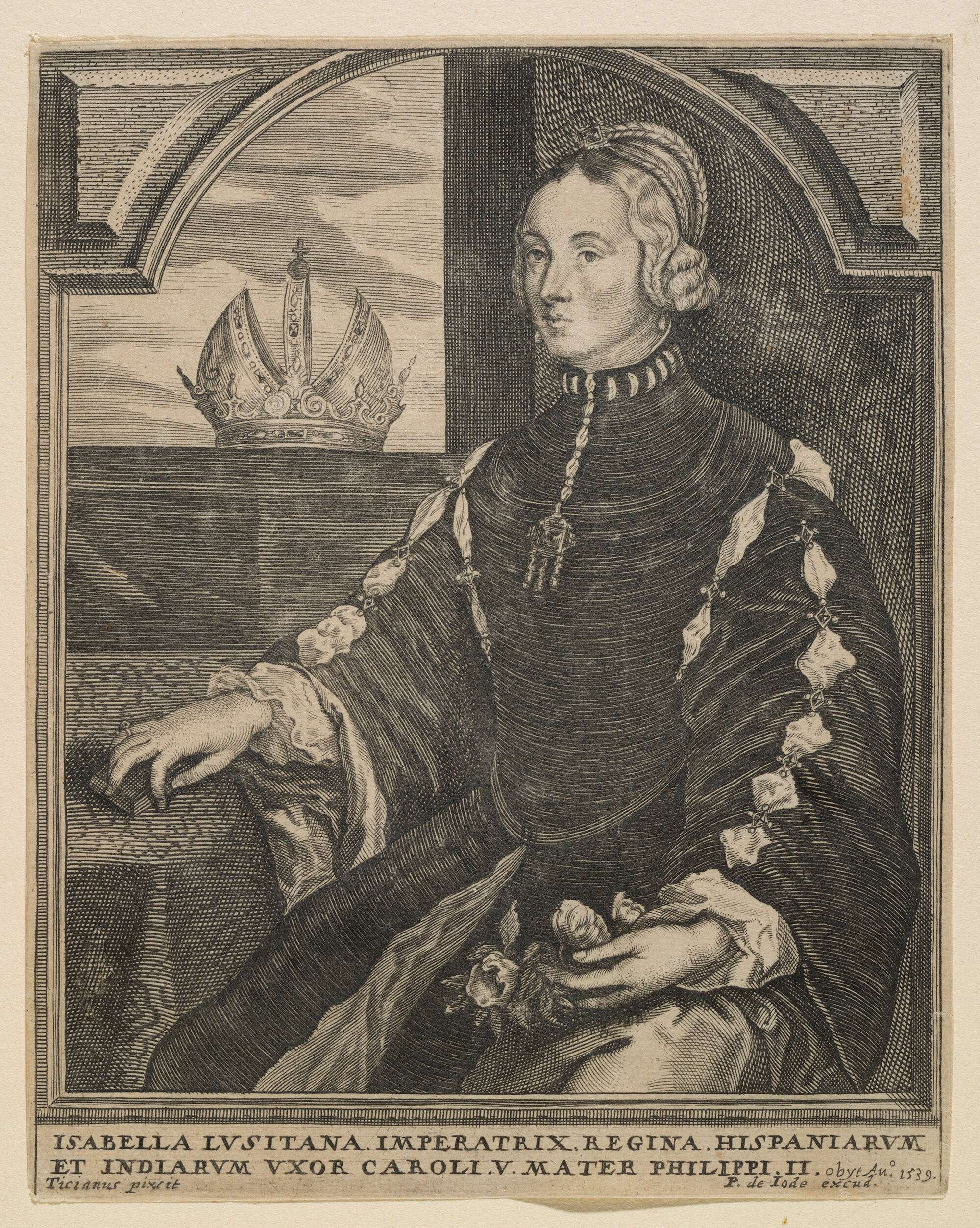
For the composition Titian turned to preexisting models. In the case of the emperor he was inspired by Emperor Charles V seated in an Armchair Portrait now in the Alte Pinakothek, Munich. For the image of the empress, who had already died by this date, he referenced a now-lost portrait of 1544, known today from an engraving by Pieter de Jode (1570-1634). Isabella of Portugal never posed for Titian, who probably based his depiction on a portrait by William Scrots (active 1537–1553), now in the Poznan Museum (Poland), making some modifications to the empress's face. The double portrait accompanied Charles V to Yuste. Subsequently, inventories of the Alcázar in Madrid record that it was in the King’s Bedroom in 1636.
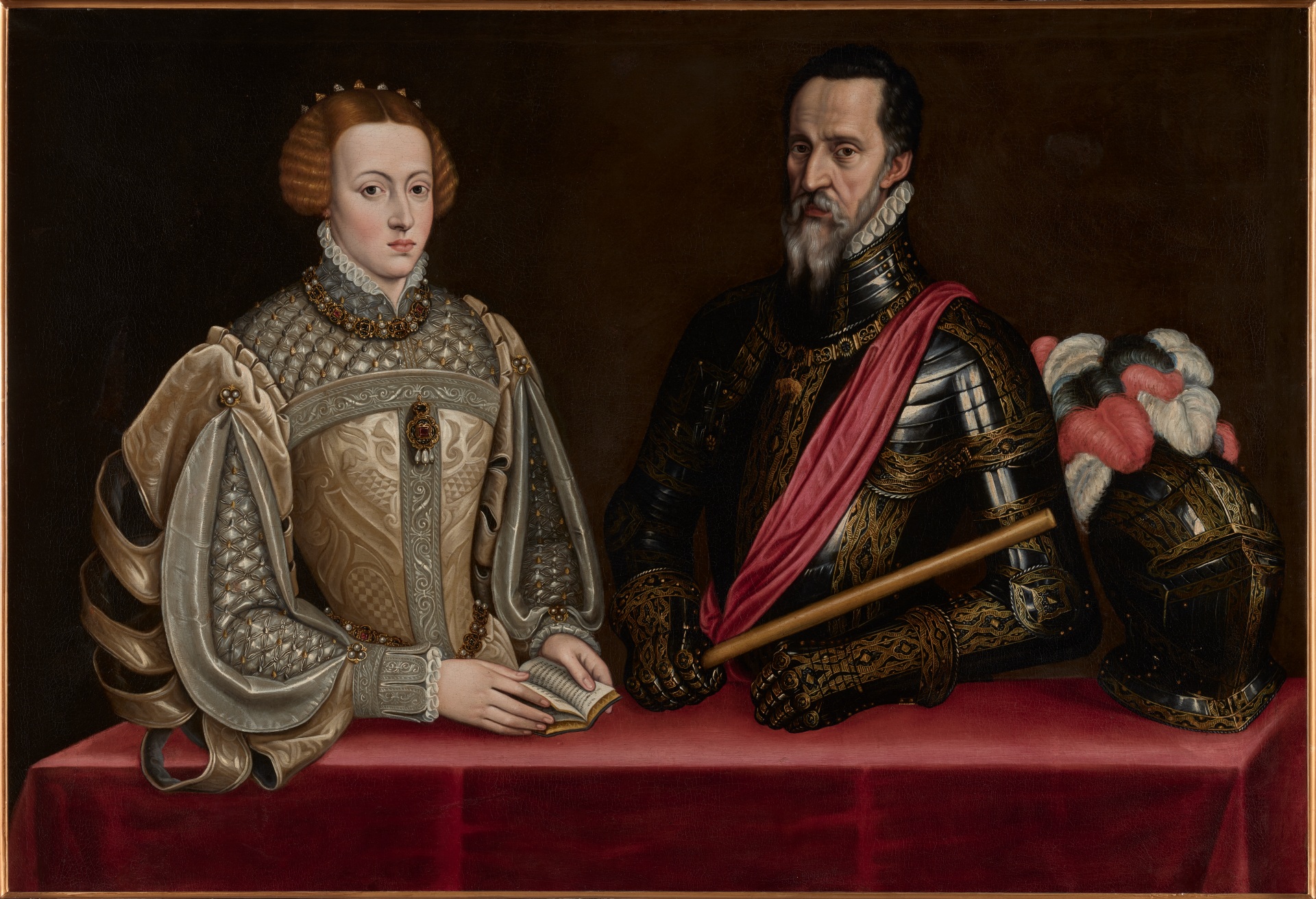
Fernando Álvarez de Toledo, 3rd Duke of Alba (1507-1582) and a courtier close to the emperor, must have known the painting since he commissioned a portrait of himself and his wife María Enríquez (1510-1583) with a similar composition, a work now in the collection of the Duke of Pastrana.

The version of Rubens

Over the course of his career Rubens copied a sizeable proportion of the works painted by his admired Titian, not only as part of his training but also as a challenge to the great masters. In 1628, during his second trip to Madrid, he produced this version, in which Charles V and Isabella of Portugal are shown dressed in black, in three-quarter profile and leaning against a table with a red cloth on it. The curtains behind them partly conceal a landscape that has been identified as the Sierra de Guadarrama near Madrid. The emperor holds a glove, while that of the empress rests on the table, possibly alluding to her death. Prominent in the centre of the composition is a clock, symbol of time.
Rubens took the portrait back to Antwerp, but after his death in 1640 his estate was auctioned. The painting was acquired by Charles I of England (1600-1649), a patron and protector of the artist. In 1847 it was exhibited at the British Institution (owner P. H. Howard); it was subsequently with Frank T. Sabin (ca. 1815/1847-1915) in London and was acquired by the Duke of Alba in 1936.

Title

The Emperor Charles V and Empress Isabella of Portugal

Type of Object

Painting

Author

Peter Paul Rubens (Siegen, 1577 - Amberes, 1640)

Date

h. 1628

Characteristics

Oil on canvas

Dimensions

1,14 x 1,64 (s.m)

Origin

Palacio de Liria, Madrid

Credits

Texts: Álvaro Romero Sánchez-Arjona, Director of Fundación Casa de Alba

Sponsors

Fundación Ramón de Areces

Collaborators

Fundación Casa de Alba

Other related works

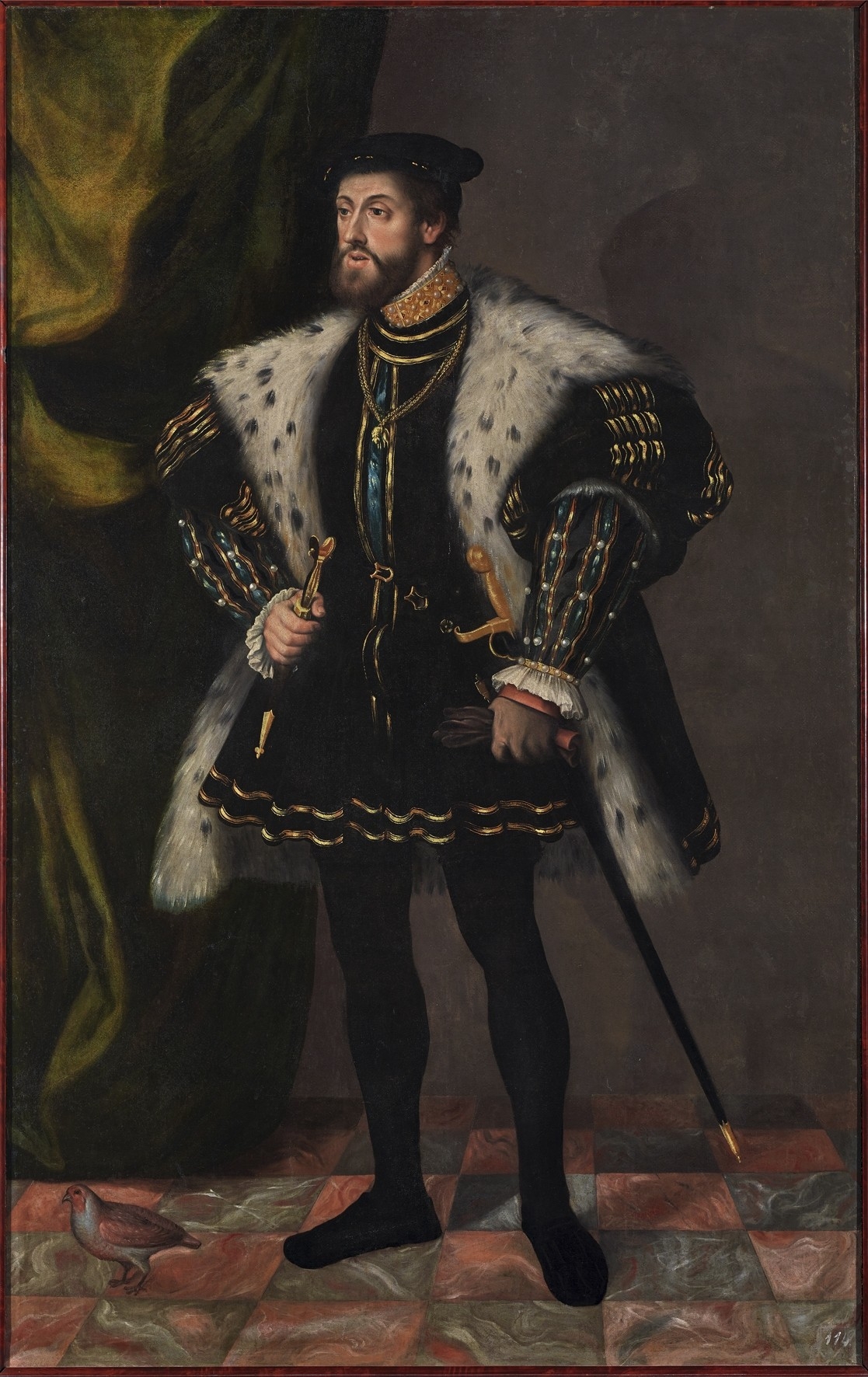
Retrato de Carlos V con un capotillo forrado en lobos cerbales
Jacob Seisenegger (1505-1567)
1530
Real Monasterio de San Lorenzo de El Escorial
10018673

La importancia de este retrato de Carlos V de Jacob Seisenegger de la colección escurialense radica en ser la primera efigie que lo representa de cuerpo entero y a tamaño natural dentro del gran número de imágenes existentes del emperador.   
El artista lo pintó en Augsburgo adonde acudió en 1530 a la Dieta de la familia Habsburgo, acompañando a Fernando de Austria, el hermano del emperador, de quien era su pintor de corte y para quien realizaría otros cuatro retratos del mismo formato entre 1530 y 1532. Fue en esta ciudad imperial donde Seisenegger encontró el ambiente perfecto para plantear la modalidad de cuerpo entero como la fórmula más idónea para representar al emperador. Dicha tipología contaba con ejemplos en el mundo germánico -Cranach, Strigel, Wertinger, Amberger e incluso en Seisenegger- e italiano –Carpaccio o Moretto-. Pero la reinterpretación llevada a cabo por el artista fue fundamental para la configuración de la imagen posterior del emperador y, en general, para la del retrato cortesano de las siguientes décadas, como así también lo fue para la copia efectuada por Tiziano de la última versión del alemán a principios de 1533 en Bolonia y que hoy se encuentra en el Museo Nacional del Prado. 

Texto: Carmen García-Frías Checa

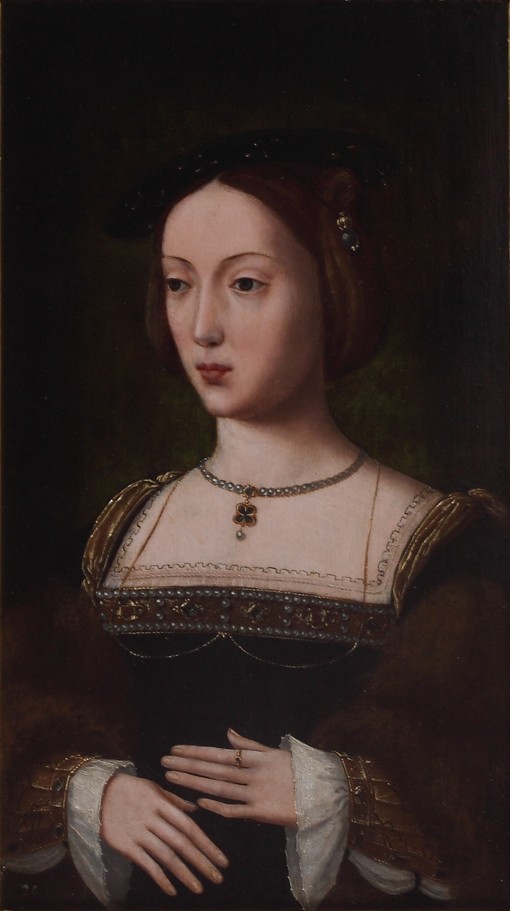
Retrato de Isabel de Portugal
Anónimo flamenco
Segunda mitad del siglo XVI 
Real Monasterio de San Lorenzo de El Escorial
10014396

Curiosamente, al morir Isabel de Portugal en 1539 su efigie casi no había sido reproducida. Carlos V tan sólo contaba con pequeños retratos en pergamino o en camafeos, que figuraban entre las piezas reunidas en su retiro de Yuste. De ahí, la necesidad que tuvo el emperador de encargar a Tiziano a lo largo de la década de los cuarenta varias efigies póstumas, que la reprodujeron de forma bien idealizada, como así lo demuestra la copia de Rubens del retrato de la pareja imperial de la Casa de Alba.
Pero la vera efigie de Isabel se encontraba en esos pequeños retratos en miniatura, que debieron de servir de modelo a todos aquellos maestros flamencos al servicio de la Casa de Austria en la corte de Bruselas, como fueron Joos van Cleve (c. 1485-1540 o 1541), Jan Cornelisz Vermeyen (c. 1504-1559) o Guillaume Scrots (activo 1537-1553). 
Patrimonio Nacional conserva un pequeño y delicado retrato de la emperatriz en sus colecciones escurialenses, que se relaciona de forma muy estrecha con este grupo de retratos flamencos contemporáneos.  Esta imagen, junto a la de su pareja con la efigie de Carlos V, figura por primera vez documentada en 1779 en la Casa de Campo de San Lorenzo de El Escorial, donde el príncipe Carlos (IV) reunió una gran parte de sus tesoros pictóricos.

Texto: Carmen García-Frías Checa

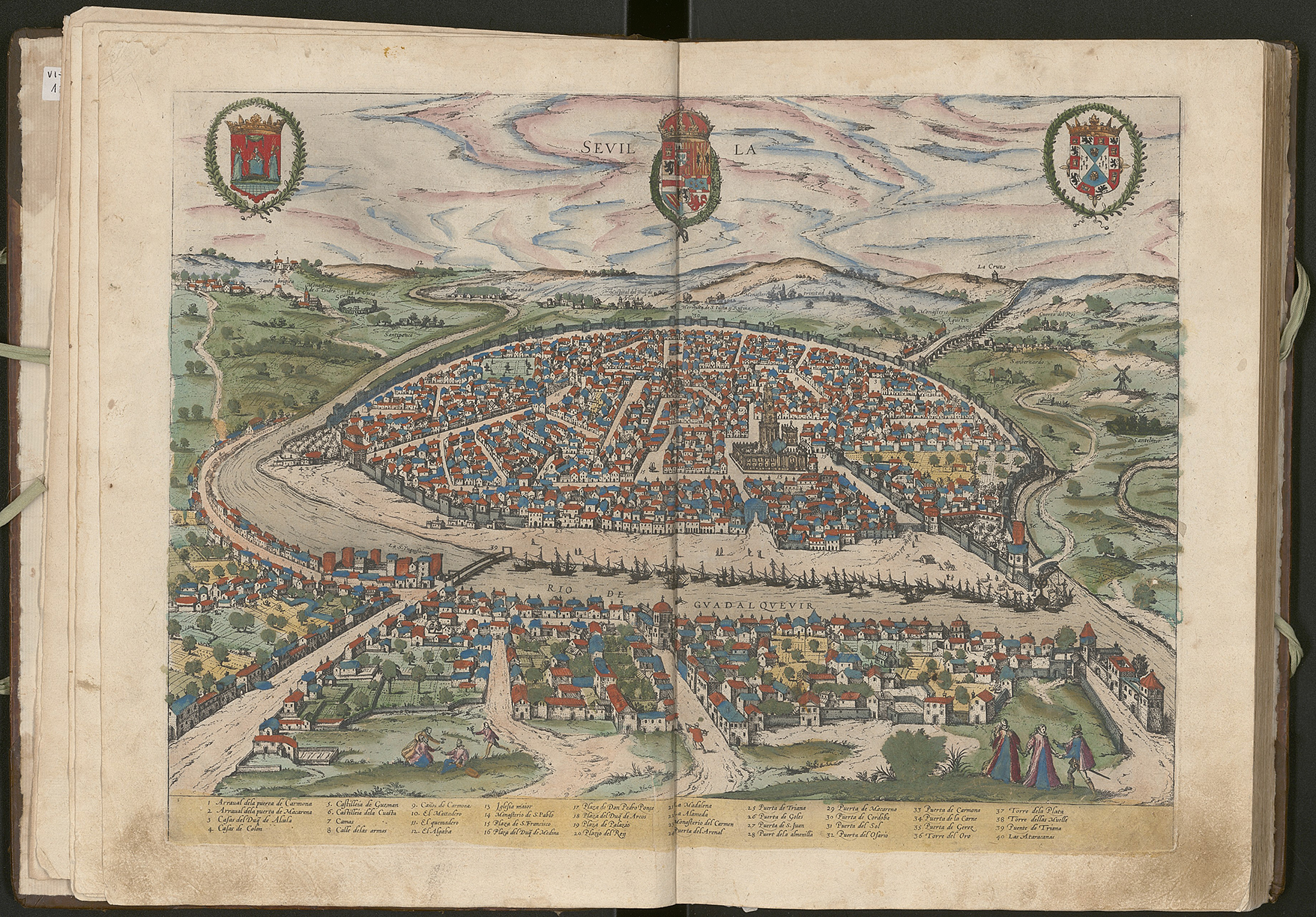
View of Seville
Printed in Cologne by Bertrami Buchholtz, 1594
Real Biblioteca
VI/F/120

From the 15th century, and with greater intensity following the Spanish arrival in the Indies in 1492, Seville saw significant economic and demographic growth. In this context of expansion, the city was chosen to host the royal wedding of Charles I and Isabella of Portugal in 1526, five hundred years ago. The ceremony took place in the Real Alcázar of Seville rather than in the great cathedral visible in this view, at midnight on the night of 12 March.
Seville became a symbol of the Crown's new and powerful momentum. Abundant goods from the Indies arrived along the Guadalquivir River, clearly depicted in this image, together with other merchandise, transforming the Andalusian capital into a major trading hub for several decades.
This image is a topographical depiction of Seville made for the celebrated publishing project of city views, Civitates orbis terrarum, by George Braun and Franz Hogenberg, comprising six volumes. This print is from the fourth volume. Publication began in 1572 and subsequent editions were published as a complement to Abraham Ortelius's atlas, of which the first edition, published in 1570, was an immediate success.
Several coats of arms are included in the upper part of the composition: in the centre, the royal coat of arms; to the right, that of the city of Seville; and to the left, that of the Guzmán family, owners of vast estates in the region. The city enthusiastically celebrated the royal decision to host the wedding there in preference to other important Castilian cities such as Toledo, Valladolid or Burgos, which would also have been suitable venues. However, these represented a monarchy of the past, whereas Seville was acquiring a historical prominence that would last for nearly two hundred years.
The royal couple stayed in the city until 13 May, after which they departed for Granada to continue their honeymoon.

Text: Valentín Moreno Gallego

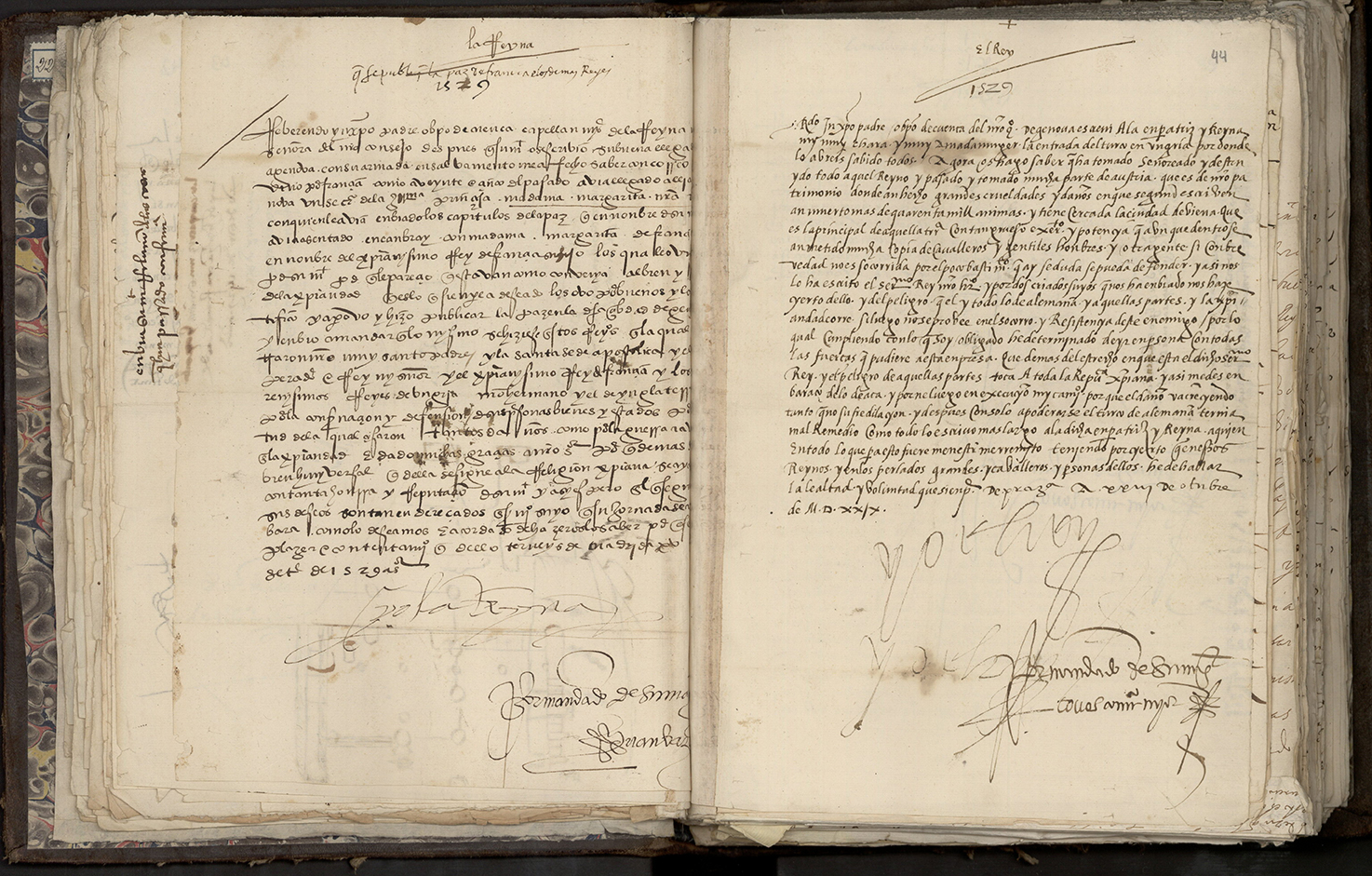
Royal dispatch of the Empress Isabella to Diego Ramírez de Villaescusa, Bishop of Cuenca. Attested by the secretary Juan Vázquez de Molina
Madrid, 20 September 1529
Real Biblioteca
II/2205, doc. 43

Charles I left his Iberian realms in 1529. On 27 July he sailed by galley from Barcelona to Italy, having previously left Castile to attend the Aragonese Cortes in Monzón the year before. He did not return until April 1533. These were four intense years, most notably his imperial coronation in Bologna the year after his departure. Subsequent absences would follow.
From the time of their marriage, the emperor recognised Isabella’s prudent character, well-suited to serve as regent of Castile and the other peninsular kingdoms. From 1529, the queen thus assumed the regency in accordance with the provisions of a 1528 Instruction, later expanded to grant her greater powers when Charles embarked on his absence from the country. This royal dispatch reveals the importance of the matters addressed by Isabella, such as the dissemination of the Treaty of Cambrai with France, a task entrusted to Diego Ramírez de Villaescusa.
This peace, also known as the "Ladies' Peace", was negotiated by Margaret of Austria and Louise of Savoy. Isabella exercised the regency prudently, supported by councils and ministers, though she also acted according to her own judgment, as her letters reflect. A comparison between one of her royal dispatches and another from the monarch concerning his campaign in Hungary against the Ottomans demonstrates Isabella's political status, comparable to that of the emperor.

Text: Valentín Moreno Gallego

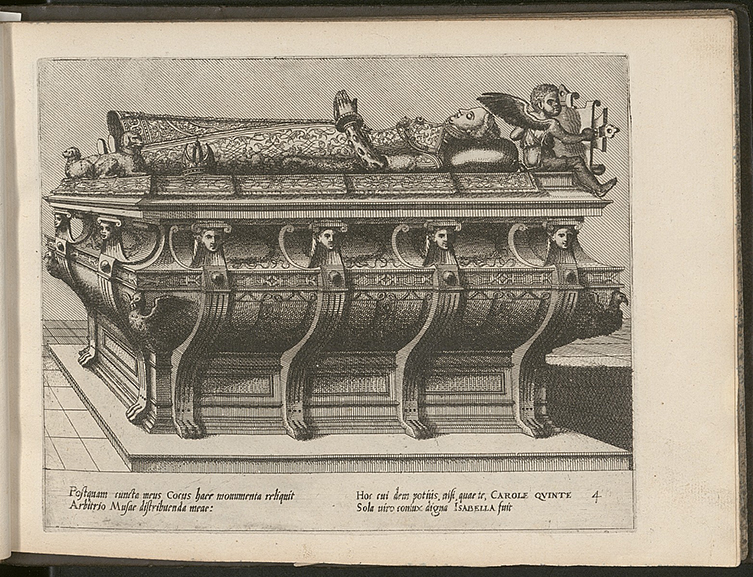
Tomb of Empress Isabella of Portugal
Johannes van Doetechum
Printed in Antwerp by Hieronymus Cock, 1563
Real Biblioteca
GRAB/200 (1)

The death of the empress from severe puerperal fever in Toledo on 1 May 1539 was a profound shock. It particularly affected Charles and his son, the Prince of Asturias, who were in Madrid, as well as the entire court and the kingdoms of Spain. Charles remained secluded for a month in the Toledo monastery of La Sisla, while his son was unable to preside over the funeral procession due to his profound consternation at his mother's death. Ultimately, it was Isabella's equerry, Francisco de Borja, Duke of Gandía, who led the cortege. At the empress's express wish, she was buried in Granada next to her grandmother of the same name. Isabella’s meticulousness is reflected in her drafting of several wills. In 1574 her remains were transferred to the Monastery of San Lorenzo de El Escorial by royal decree.
Before that date Isabella was buried in a marble tomb, known from an etching by Johannes van Doetechum, who also depicted the emperor's funeral procession. This engraving was printed by Hieronymus Cock in Antwerp in 1563 as part of a series depicting notable tombs and cenotaphs. Doetechum worked in the Netherlands during the second half of the century, primarily producing atlases.
The print shows a humanised image of the empress, even though posthumous. Above her head is a cupid, a symbol of her love for Charles, while at her feet are two greyhounds, alluding to her fidelity and loyalty to the emperor. The tomb was probably made by Pietro de Carona, an expert in carving Carrara marble, who decades later also sculpted the tomb of Joanna of Castile for the same Royal Chapel in Granada.

Text: Valentín Moreno Gallego

Authors and Collectors

Charles I of Spain and V, Holy Roman Emperor
Monarch

Charles I of Spain and V, Holy Roman Emperor

(Gante (Bélgica), 1500 - Yuste (Cáceres), 1558)

The second of six children born to Joanna I (1479-1555) and Philip the Handsome (1478-1506), the future Charles I of Spain and V, Holy Roman Emperor spent his childhood in Mechelen (Belgium). Count of Flanders and Lord of the Netherlands since the death of his father in September 1506, his aunt, Archduchess Margaret of Austria (1480-1530) –the widow of Prince John (1478-1497), second son of the Catholic Monarchs, and younger sister of Philip the Handsome– ruled as Regent until he attained his majority in 1515. He was educated by Adriaan Florensz Boeyens, the future Pope Adrian VI. Although Prince Charles had a Spanish tutor, Luis Cabeza de Vaca, his childhood and early youth were spent in a predominantly French-speaking cultural environment.

On 11th March 1526, he married Isabella of Portugal (1503-1539) in Seville. The royal couple had five children: the future Philip II (1527-1598); the Infanta Maria of Austria (1528-1603), who was Holy Roman Empress by marriage to Maximilian II of Austria; the Infante Fernando (1529-1530); the Infanta Joanna (1535-1573), Crown Princess of Portugal by marriage to Prince John - eldest son of the Portuguese monarch John III and Catherine, sister of Charles V; and the Infante Juan (1537-1538). After the death of Isabella of Portugal on 1st May 1539, Charles I remained a widower for the rest of his life. The King also sired two children out of wedlock: Margaret of Austria (1521-1586), Duchess of Parma by marriage first to Alessandro de' Medici, Duke of Florence, and later to Ottavio Farnese, Duke of Parma, and future Governor of the Netherlands; and John of Austria (1547-1578), one of the architects of the victory of Lepanto against the Ottomans on 7th October 1571.

Charles I became King of Spain after the death of his maternal grandfather, Ferdinand the Catholic, on 25th January 1516. Due to the mental instability of his mother, Queen Joanna, it was decided that the new King should reign jointly with her, even though she was placed in seclusion in Tordesillas until her death on 12th April 1555. On 28th June 1519, Charles was elected Holy Roman Emperor as Charles V, following the death of his paternal grandfather, Emperor Maximilian I, in January that same year.

The start of the new reign was characterised by instability. Failure to comprehend the monarch's European interests, in addition to the prevailing unrest in major cities, and Charles I's initial mistakes, such as the bequests and public offices awarded to some of his Flemish advisers, led to the 1952 Revolt of the “Comuneros” in Castile and the Revolt of the Brotherhoods in Valencia and Mallorca. Both insurrections, which challenged royal authority, lasted until 1522, when they were finally put down by forces loyal to the King, and the latter approved the granting of a "general pardon". Other factors that contributed to the restoration of normality were the greater integration of local elites in the administration of the Monarchy, the continuity of some of the institutional reforms initiated by the Catholic Monarchs, such as increasing the number of government councils, and the presence in Spain of Isabella of Portugal, the King's wife who governed in his absences, as well as the presence of his children.

As King, Charles I aspired to consolidate the position of the Hispanic Monarchy as a hegemonic power within European international relations. Throughout his reign, Charles’ foreign policy was conditioned by the rivalry with France and the Ottoman Empire, the consequences of the religious rift in Germany, and numerous military fronts on which the monarch was waging war. Spain’s involvement in European conflicts in the first half of the 16th century resulted in notable victories such as those of Pavia (1525) and Mühlberg (1547), the capture of Tunis (1525) and the inclusion of the Duchy of Milan in the territories under the Hispanic Monarchy (1540); but also major defeats such as the Algiers Expedition (1541), the hasty flight of Charles I from Innsbruck (1552), or the signing of the Peace of Augsburg (1555), which made the legal division of Christianity permanent within the Holy Roman Empire. In parallel with its results in Europe, the conquest of the Aztec and Incan empires by armies under Hernán Cortes and Francisco Pizarro in 1521 and 1533 respectively; the creation of the viceroyalties of New Spain (1535) and Peru (1542) in the American continent; and the completion of the first round-the-world voyage by Ferdinand Magellan and Juan Sebastián Elcano between 1519 and 1522 are worth highlighting.

Disappointed with the results of his foreign policy, between October 1555 and January 1556, Charles I renounced the territories under the sovereignty of the Hispanic Monarchy in favour of his son, Philip II, while the Crown of Holy Roman Emperor passed to his brother Ferdinand (1503-1563). After his abdication, the King returned to Spain. In February 1557, he moved into a Palace annexed to the Monastery of Yuste (Cáceres), where he died on 21st September 1558. The remains of Charles I are buried in the Pantheon of Kings and Queens in the Monastery of El Escorial.

Source: Royal Academy of History (https://www.rah.es)

Read more
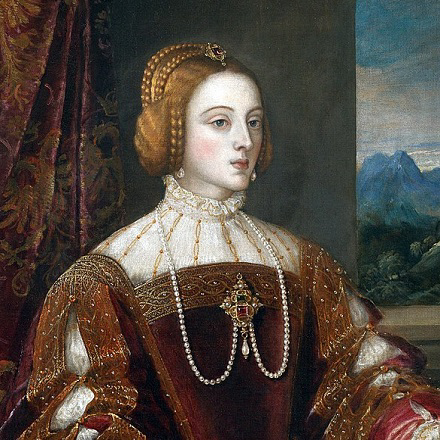
Isabella of Portugal
Monarch

Isabella of Portugal

(Lisboa, 1503 - Toledo, 1539)

Second daughter of King Manuel I of Portugal (1469-1521) and the Infanta Maria of Aragón (1482-1517), Isabella of Portugal was brought up at the royal court in Lisbon, which was frequented, amongst other literary figures, by the great playwright Gil Vicente. Her education was supervised by her mother who was the fourth daughter of the Spanish Catholic Monarchs. In addition to various modern languages and Latin, which she translated and spoke fluently, Isabella of Portugal also learned to play several musical instruments and came into contact with the various intellectual currents of Renaissance humanism.

Her marriage to Charles I (1500-1558), arranged in 1525, was celebrated in Seville on 11th March 1526. Despite being separated for long periods of time due to the king's frequent political and military travels, they had a close and harmonious marriage. The royal couple had five children: the future Philip II (1527-1598); the Infanta Maria of Austria (1528-1603), Holy Roman Empress by marriage to Maximilian II of Austria; the Infante Fernando (1529-1530); the Infanta Joanna (1535-1573), Crown Princess of Portugal by marriage to Prince João Manuel - eldest son of the Portuguese king John III and Catherine, sister of Charles V; and the Infante Juan (1537-1538).

Isabella of Portugal played a highly prominent political role. After her marriage, she not only acted as intermediary between her husband's interests and those of her native Portugal, but from 1529 onwards, she also acted as Governor whenever Charles I was in Europe. The Queen's main political concerns included defending Spain’s borders with France, economic affairs, and mediating in court disputes, where she played the role of arbiter following the King's instructions. In addition to her dedication to governing, Isabella of Portugal was also directly involved in the education of her children, personally choosing their teachers and tutors.

Isabella of Portugal died in Toledo on 1st May 1539 from complications arising from her last childbirth while Charles I was in Madrid. Her remains are buried in the Pantheon of Kings and Queens in the Monastery of El Escorial. After her death, Charles I refused to remarry and remained a widower until his death.

Source: Royal Academy of History (https://www.rah.es)
Read more
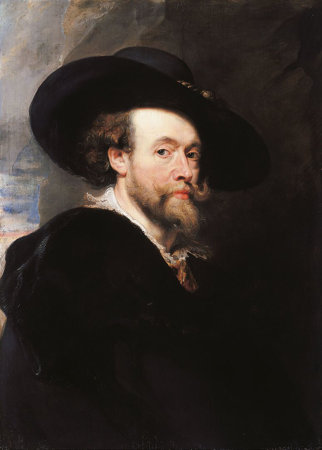
Rubens, Peter Paul
Author

Rubens, Peter Paul

(Siegen (Germany), 1577 - Antwerp (Netherlands), 1640)

Peter Paul Rubens (Siegen, Holy Roman Empire, present-day Germany, 28th June 1577 - Antwerp, Duchy of Brabant, Habsburg Netherlands, present-day Belgium, 30th May 1640), also known as Peter Paul Rubens, Pieter Paul, Pieter Pauwel or Petrus Paulus, was a Flemish Baroque painter. His exuberant style emphasised dynamism, colour and sensuality. His main influences were Ancient Greek and Roman art and the Italian Renaissance painters, especially Leonardo da Vinci; Michelangelo, whose depiction of anatomy he admired; and above all Titian, whom he considered his master and of whom he stated that "with him, painting has found its essence".

He painted a wide variety of subjects: religious and historical scenes, classical mythology, hunting scenes, landscapes, portraits, as well as drawings, illustrations for...

Read more
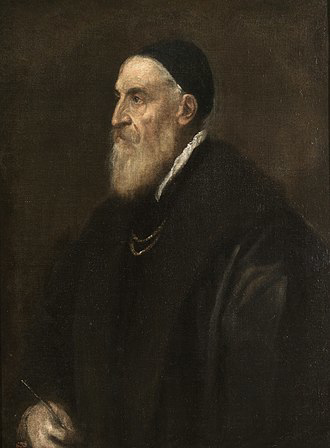
Vecelli, Tiziano
Author

Vecelli, Tiziano

(Pieve di Cadore, Belluno, Veneto, 1488 - Venecia, 1576)

Tiziano Vecellio di Gregorio or Titian in English (Pieve di Cadore, Belluno, Véneto, circa 1488/1490 - Venice, 27th August 1576),​ was an Italian Renaissance painter and one of the greatest exponents of the Venetian School.

Hailed by his contemporaries as "the sun amidst small stars” in reference to the final line of Paradiso in Dante Alighieri's Divine Comedy, Titian was one of the most versatile Italian painters, equally capable of painting portraits, landscapes (two of the subjects that would bring him fame), mythological scenes, and religious topics. He had a long career, during which his work passed through many different stages, undergoing such drastic stylistic changes that some critics find it hard to believe that his early and later paintings...

Read more