Loading...

Casa de los Borbones
Isabella II
Madrid, 10 de October de 1830 - París (Francia), 09 de April de 1904
View in TimelineBiography
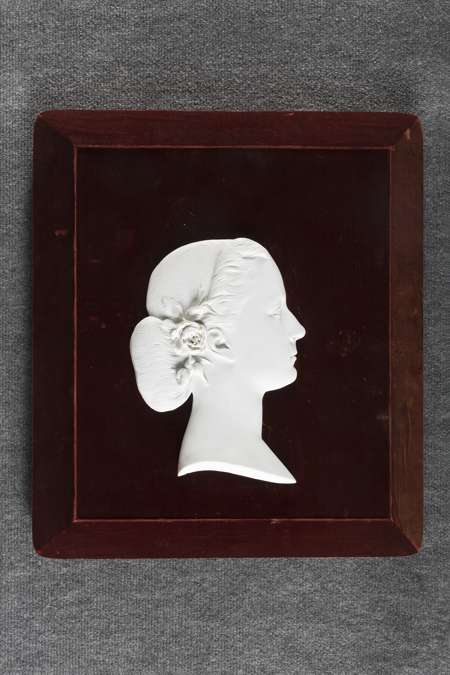
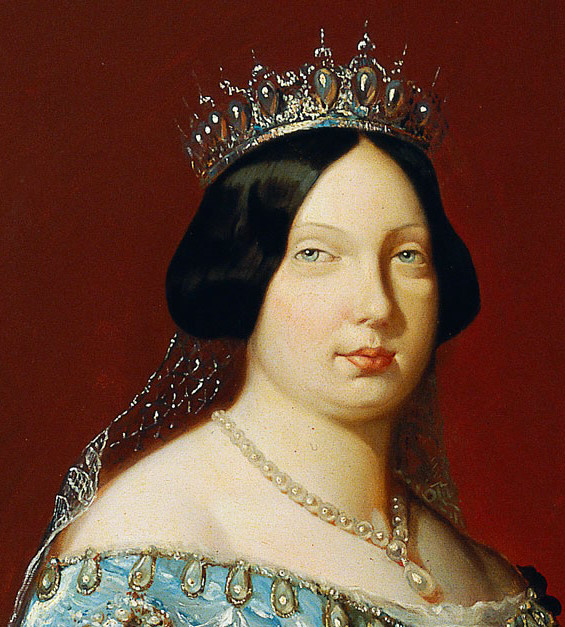
The first-born daughter of Ferdinand VII (1784-1833) and his fourth wife, Maria Christina of the Two Sicilies (1806-1878), the future Isabella II was sworn in as Princess of Asturias before the Spanish Cortes in the Church of San Jerónimo El Real in Madrid, on 20th June 1833. Barely three months later, she became Queen of Spain after the death of Ferdinand VII on 29th September that same year. During her minority, her mother Queen Maria Christina, and later General Baldomero Espartero, acted as regents. Isabella II's childhood was marked not only by the outbreak of the first Carlist War (1833-1840), which called into question her legitimacy as Queen against the supporters of her uncle, the Infante Carlos María Isidro (1788-1855), but also by internal conflicts within Spanish Liberalism, specifically between the moderate and progressive parties. This situation affected the education of the child Queen, who was somewhat neglected despite having the illustrious Manuel José Quintana and Agustín Argüelles as tutors.
Isabella II attained her majority on 15th October 1843, after a military uprising deposed General Baldomero Espartero, who served as Regent of Spain from May 1841 onwards, after Maria Christina. In 1846, the moderate cabinet presided over by Francisco Istúriz arranged the Queen’s marriage to her cousin, the Infante Francisco de Asís de Borbón (1822-1902), after France and England had respectively vetoed the two German and French Princes who had sought the Queen’s hand, and after the failure of the movement to unite Isabella II with her cousin, Carlos Luis María Fernando de Borbón y Braganza (1818-1861), son of the Carlist Pretender.
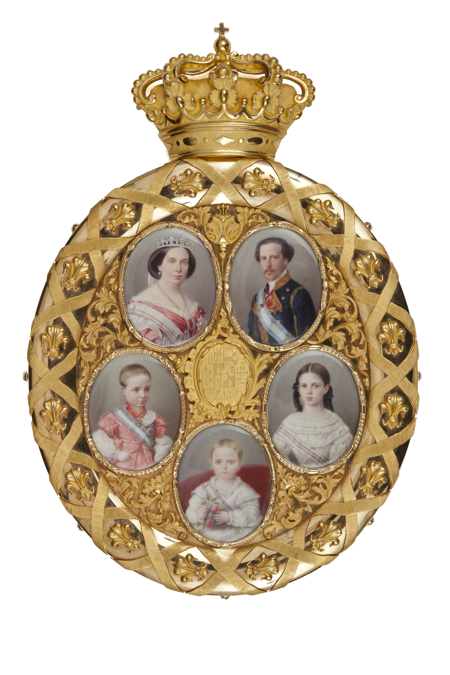
Finally, the Queen’s wedding was held at the Royal Palace of Madrid on 10th October 1846. Isabella II and Francisco de Asís de Borbón, named King consort after their marriage, had ten children: Prince Luis (born and died in 1849); Prince Fernando (born and died in 1850); the Infanta Isabel (1851-1931), Countess of Girgenti by her marriage to Gaetan of the Two Sicilies, Count of Girgenti (1846-1871); the Infanta María Cristina (born and died in 1854); the future Alfonso XII (1857-1885); the Infanta Maria de la Concepción (1859-1861); the Infanta Pilar (1861-1879); the Infanta María de la Paz (1862-1946), Princess of Bavaria married to Prince Ludwig Ferdinand of Bavaria (1859-1949); the Infanta Eulalia (1864-1958), Duchess of Galliera by her marriage to the 4th Duke of Galliera (in Italy), Antonio de Orleans y Borbon (1866-1930); and finally the Infante Francisco de Asís Leopoldo (born and died in 1866).
The reign of Isabella II was marked by political instability. The duration of the governments of the period was conditioned by frequent military uprisings, such as the July Revolution of 1854, as well as by the Queen's inability to set herself up as a neutral arbiter in the disputes between the moderate and progressive parties. Nevertheless, during the so-called "Isabelline Era”, the consolidation of the constitutional regime in Spain continued with the promulgation of the Constitutions of 1837 and 1845, while at the same time a whole series of measures were implemented that promoted the introduction of a liberal political, social and economic model: for example, the creation of the Guardía Civil or Civil Guard in 1844, the tax and administrative reforms of 1845, the construction of the Palacio de las Cortes or House of Parliament (1843-1850), the draft Civil Code of 1851, the General Railway Act and the General Disentailment Act of 1855, and the Education Acts of 1847, 1855 and 1857, amongst other legislative provisions. The reign of Isabella II also marked a period of modernisation and economic progress for Spain. The expansion of the railways and the telegraph, the start of the growth of Madrid and Barcelona, the first electric lighting tests, the spread of photography, the creation of the public water supply company Canal Isabel II in 1851, the founding of the Bank of Spain in 1856, and the boost to the country's industries and mines, were some of the achievements of this period. This progress also extended to the world of culture with the inauguration of the Royal Theatre in Madrid in 1850, the expansion of the Prado Museum collections in 1865, and the founding of educational centres of different levels, as well as the current headquarters of the National Library of Spain, of which the Queen laid the foundation stone on 21st April 1866.
The last stage of Isabella II's reign was marked by the development of the "prestigious" foreign policy encouraged by General Leopoldo O'Donnell, which culminated in the first Moroccan War (1859-1860), among other conflicts; by the economic crisis and growing social unrest; and by opposition to Isabella's rule from progressives, republicans and democrats, who conspired against the Queen in the so-called "Ostend Pact" (signed on 16th August 1866), which was joined by certain sectors of the Liberal Union and moderate parties after the successive deaths of their respective leaders, Generals Leopoldo O'Donnell and Ramón Narváez. Dethroned after the Revolution of September 1868, Isabella II went into exile in Paris, where she lived at the so-called Palace of Castile. Two years later, on 25th June 1870, the Queen renounced her dynastic rights in favour of her son, Prince Alfonso, the future Alfonso XII. She never resided permanently again in Spain, and died in the French capital on 9th April 1904. The remains of Isabella II are buried in the Pantheon of Kings and Queens in the Monastery of El Escorial.
Source: Royal Academy of History (https://www.rah.es)