Loading...

Casa de los Austrias
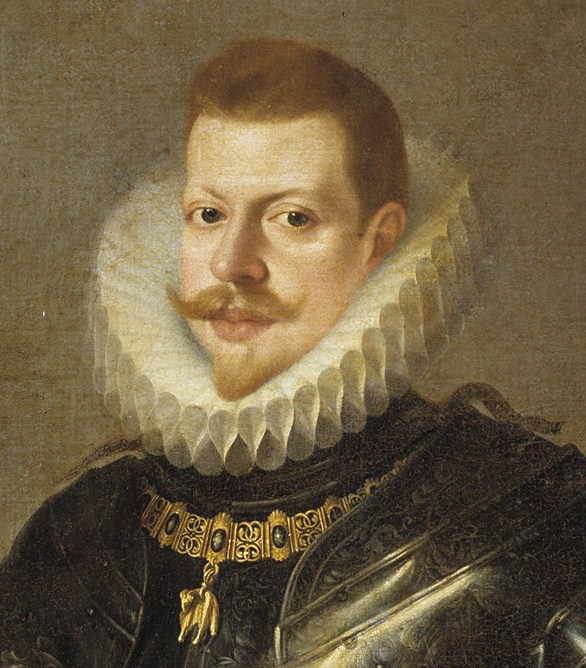
Philip III
Madrid, 14 de April de 1578 - Madrid, 31 de March de 1621
View in TimelineBiography
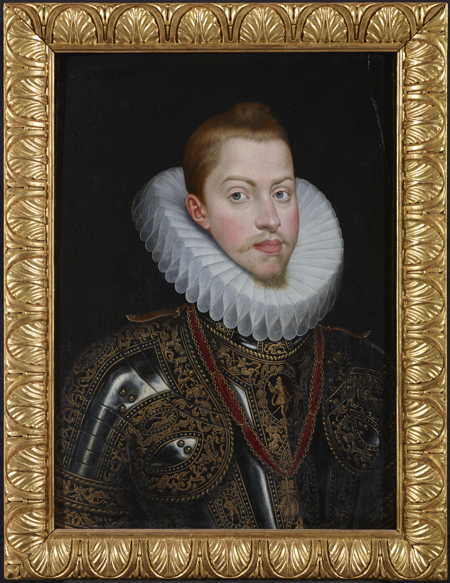
The fourth of five children born to Philip II (1527-1598) and his last wife, Anna of Austria (1549-1580), the future Philip III became heir to the Crown after the death of his older brothers, Princes Ferdinand and Diego, in 1578 and 1582 respectively. Prince Philip’s education was supervised by his tutor, García de Loaysa y Girón, who designed an educational programme that included subjects such as History and Geometry, languages (Latin, French and Portuguese) and classical and modern works of literature. In the early 1590s, Philip II ordered the Prince to participate in the sessions of the Government Council. Thereafter, the latter not only began to gain experience in how to conduct affairs of state, but he also had the opportunity to comprehend the political struggles at court and in government institutions. From 1592 onwards, the Prince became friends with Francisco Gómez de Sandoval y Rojas, Marquess of Denia and future Duke of Lerma, who would subsequently exercise great influence over him.
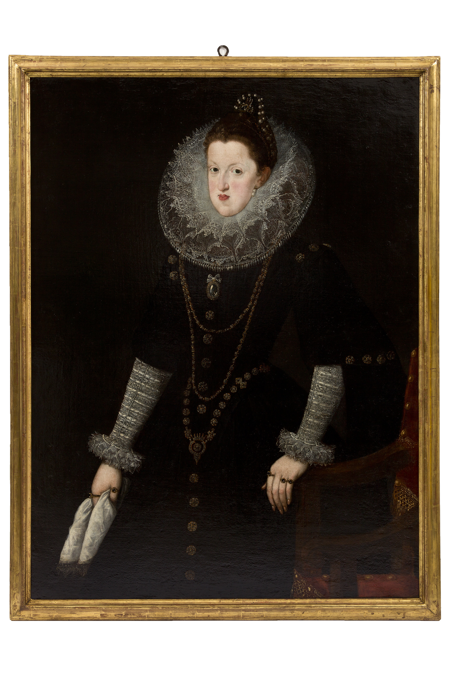
After his father Philip II died on 13th September 1598, Philip III became King of Spain. A few months later, he married the Archduchess Margaret of Austria (1584-1611) in Valencia on 18th April 1599. The King and Queen were a well-suited couple who had eight children: the Infanta Anne (1601-1666), Queen of France by marriage to Louis XIII (1601-1643); the Infanta María (born and died in 1603); the future Philip IV (1605-1665), who succeeded his father on the throne; the Infanta Maria Anna (1606-1646), Holy Roman Empress by marriage to Ferdinand III (1608-1657); the Infante Charles (1607-1632); the Infante Ferdinand (1609-1641), also known as the Cardinal-Infante; the Infanta Margarita (1610-1617) and the Infante Alfonso (1611-1612). Margaret of Austria died on 3rd October 1611, making Philip III a widower.
From the very onset of the new monarchy, the Duke of Lerma, the King’s favourite, played a key political role as the intermediary between the King and government institutions. Within the sphere of international relations, Philip III’s main concern after becoming King was to develop a foreign policy based on armed neutrality. Aware of the demands on the Royal Treasury due to several Spanish military interventions in Europe, both the monarch and his favourite signed various diplomatic agreements with European powers that had, until then, been enemies of the Hispanic Monarchy. A first step in this direction was the signing of the Anglo-Spanish Treaty of 1605, followed by the Twelve Years' Truce with the United Provinces in 1609, and the arrangement of a double wedding with the House of Bourbon that was reigning in France. These diplomatic measures were accompanied by the strengthening of Spain's military potential, as well as the introduction of financial reforms and stimulating Spain’s economy, which had been in progressive decline since the early 1590s.
The reformist efforts of Philip III and his ministers did not meet with success. On the contrary, certain measures adopted during his reign, such as the expulsion of the Moors decreed in 1609, were detrimental to the economy of certain areas. As for the King and the Duke of Lerma’s foreign policy, it was severely criticised by certain courtiers, ministers and bureaucrats opposed to the Royal Favourite, who considered it excessively favourable to the interests of the European adversaries of the Hispanic Monarchy. This perception, together with other political, diplomatic and dynastic factors, influenced Spain’s subsequent involvement in the Thirty Years' War, which broke out in mid-1618.
By this time, the Duke of Lerma had lost much of his influence over the King due to accusations of corruption against some of his trusted men, such as Alonso Ramírez del Prado, Pedro Franqueza and Rodrigo Calderón. He was succeeded by his son Cristóbal Gómez de Sandoval y de la Cerda as Royal Favourite until the death of Philip III in Madrid on 31st March 1621. The King’s remains are buried in the Pantheon of Kings and Queens in the Monastery of El Escorial.
Source: Royal Academy of History (https://www.rah.es)