Loading...

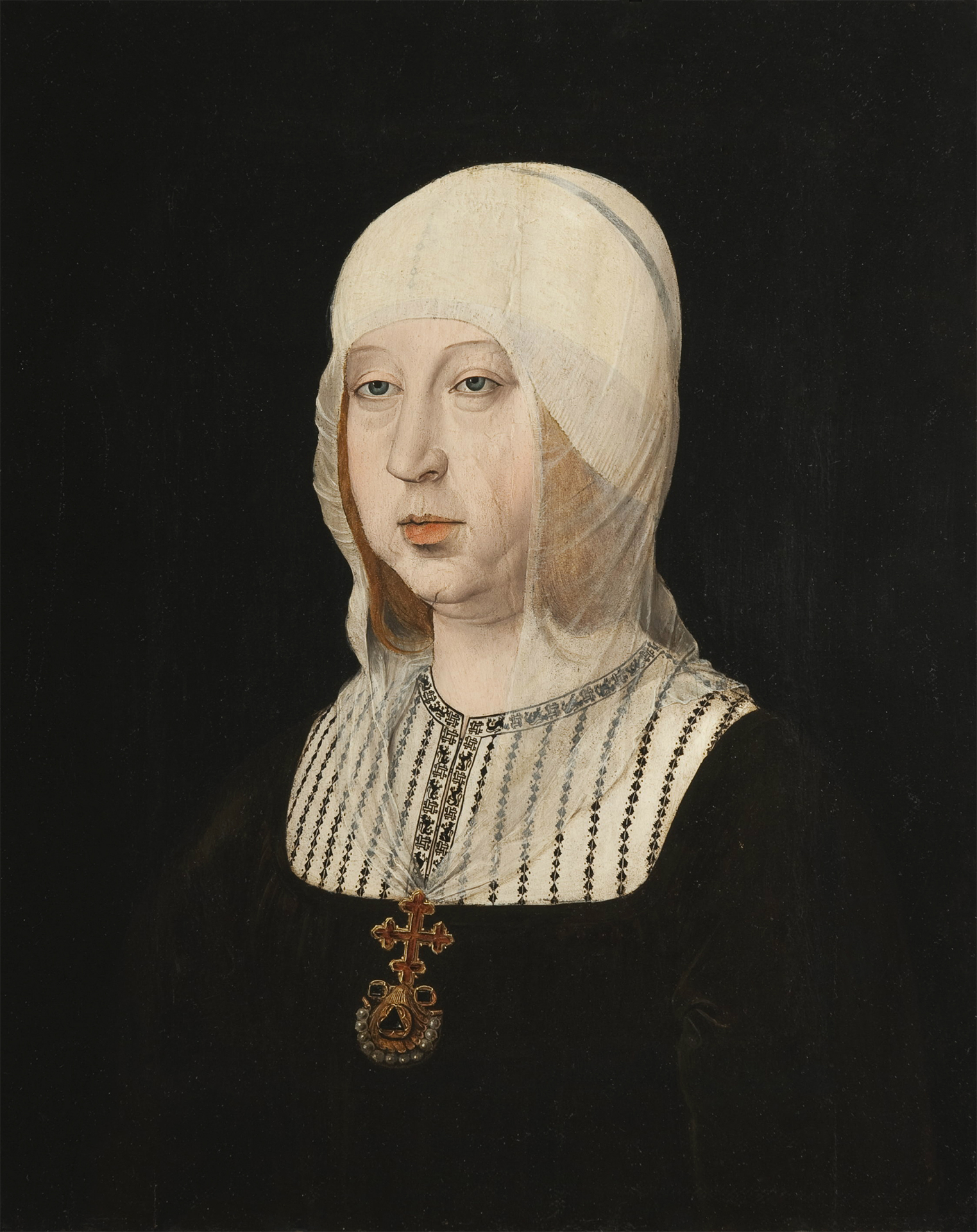
Reyes Católicos
Isabella I of Castile
Madrigal de las Altas Torres (Ávila), 22 de April de 1451 - Medina del Campo (Valladolid), 26 de November de 1504
View in TimelineBiography
Daughter of King John II of Castile (1405-1454) and his second wife, Isabella of Portugal (1428?-1496), the future Isabella the Catholic barely knew her father, who died in July 1454.
Her early years were spent in Arévalo (Ávila), in the company of her mother and her brother, the Infante Alfonso (1453-1468). The then-Infanta Isabella was taught by Fray Martín de Córdoba, her tutor, under the supervision of Gonzalo Chacón, Commander of Montiel. Little is known about her childhood education although as an adult, she did learn Latin, the language of culture and diplomacy in late 15th-century Europe, thanks to Beatriz Galindo, also called La Latina. The Infanta Isabella and her brother Alfonso left Arévalo in 1461 to settle at the court of her half-brother, King Henry IV of Castile (1425-1474). At the end of September 1468, after the death of the Infante Alfonso, a conflict between Henry IV and sections of the Castilian nobility led to the signing of the "Treaty of the Bulls of Guisando" (Ávila). This agreement stripped the succession rights of the King's daughter Joanna, also called La Beltraneja, whose legitimacy was in dispute, and recognised the Infanta Isabella as heir to the Crown of Castile.
The marriage of the now Princess Isabella to Ferdinand, Crown Prince of Aragón, was celebrated in Valladolid on 19th October 1469. The royal couple had five children: Infanta Isabella (1470-1498), Crown Princess and later Queen of Portugal by marriage to Manuel I (1469-1521); Prince John (1478-1497), who married Archduchess Margaret of Austria (1480-1530) and died before ascending the throne; the future Joanna I (1479-1555), also called Joanna the Mad,wife of Philip I the Handsome (1478-1506); the Infanta Maria (1482-1517), Queen of Portugal by marriage to Manuel I (1469-1521), the widower of her elder sister Isabella; and the Infanta Catherine (1485-1536), Princess of Wales by her marriage to Arthur Tudor (1486-1502) and then, after being widowed, Queen of England as the first wife of Henry VIII (1491-1547).
Isabella I was proclaimed Queen of Castile in Segovia on 13th December 1474, following the death of her half-brother Henry IV. The Queen's main concern after her proclamation was to consolidate her position in Castile against the claims of her niece, Joanna La Beltraneja, who was supported by Alfonso V of Portugal and some Castilian towns and nobles led by the Marquess of Villena. The succession conflict was settled in favour of Isabella after Ferdinand's victory at the Battle of Toro (Ávila) on 1st March 1476, and it ended with the signing of the Treaties of Alcaçovas-Toledo between Castile and Portugal in September 1479. In January that same year, Ferdinand became King of the Crown of Aragón. His accession to the throne brought about the dynastic union of the two great peninsular kingdoms of Castile and Aragón, although both continued to maintain their own laws, institutions and currencies.
As Queen of Castile, Isabella I, in collaboration with Ferdinand, sought to boost royal power and guarantee the internal order of the Kingdom. The King and Queen laid out their government plan at the Cortes of Madrigal (1476) and Toledo (1480). They enacted a series of measures renewing the institutional order of the Monarchy such as the compilation of laws known as the "Montalvo Ordinance”, reforming the Royal Council, the creation of the Holy Brotherhood peacekeeping force, the definitive establishment of the Royal Chancery in Valladolid, and appointing “corregidores” to oversee municipal authorities, among other provisions.
Religion was another significant concern of Isabella I's government. The Queen supported the plans to reform the Spanish clergy put forward by Fray Hernando de Talavera and the future Cardinal Cisneros; as well as establishing a new Inquisition to ensure religious purity. As a means to further achieve religious unity, she decreed the expulsion of Jews and Muslims (Mudejars) who refused to convert to Catholicism in 1492 and 1501-1502 respectively. Two important events during Isabella I's reign also had religious overtones: the capture of Granada in January 1492, which ended the Christian Reconquest begun in the 8th century, and the discovery of America by Christopher Columbus that same year. The Queen, who had partially funded the first of Columbus’ voyages despite Ferdinand's doubts as to its feasibility, encouraged evangelisation in the newly discovered territories. In 1496, Pope Alexander VI granted the King and Queen the title of "Catholic Monarchs" in recognition of their role in the defence and expansion of Catholicism.
Finally, in the cultural sphere, it should be noted that Isabella the Catholic was sensitive to the currents of Renaissance humanism and sponsored the careers of certain outstanding intellectuals of the late 15th century, such as Elio Antonio de Nebrija who dedicated the prologue of his Grammar of the Spanish Language to the Queen, Pietro Martire d'Anghiera, Lucius Marinius Siculus, and the brothers Antonio and Alessandro Geraldini.
Isabella the Catholic died in Medina del Campo on 26th November 1504. Her remains are buried next to those of Ferdinand the Catholic in the Royal Chapel adjoining the Cathedral of Granada. She was succeeded by her third daughter, Joanna, who inherited the Crown after the successive deaths of Prince John and Princess Isabella and the latter's son, the Infante Miguel da Paz of Portugal.
Source: Royal Academy of History (https://www.rah.es)