Use of Cookies

The Royal Collections Gallery uses its own and third-party cookies, mainly for technical purposes, which are necessary to provide our services and provide you with relevant content. More information in our cookies policy. Cookies Policy.

ACCEPT to confirm that you have read the information and accepted their installation. You can change your browser settings.

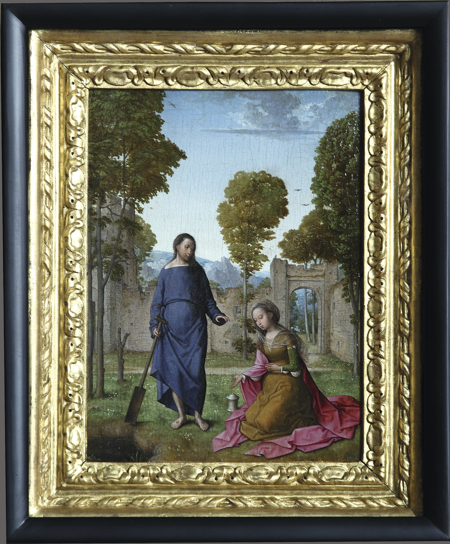
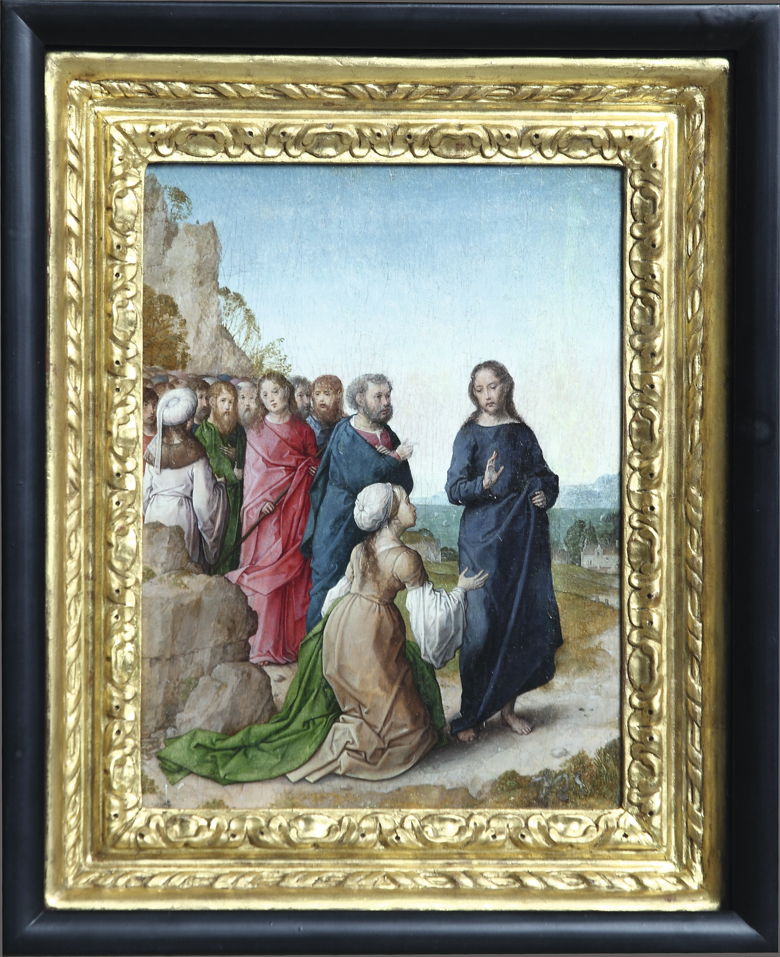
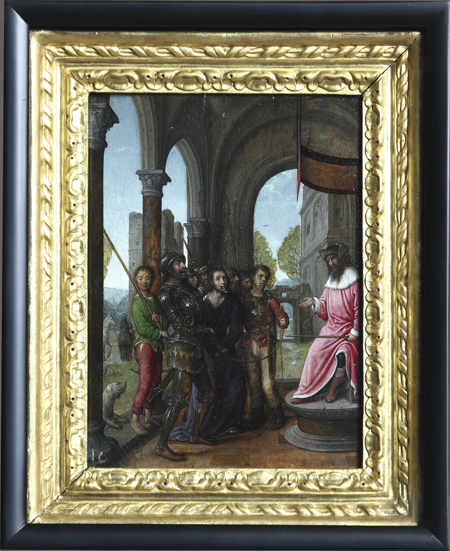
Cristo y la mujer cananea

Flandes, Juan de
1496-1504

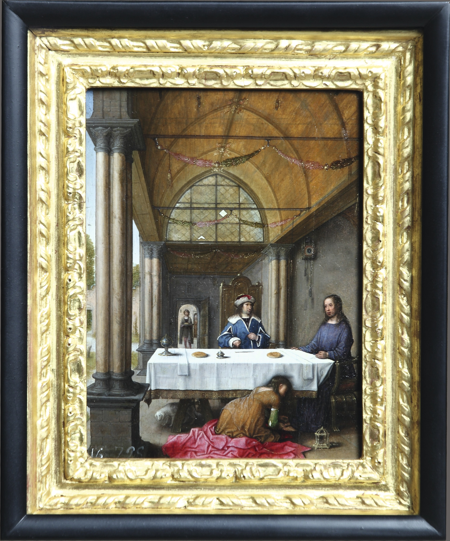
Forma parte del «Políptico de Isabel la Católica», junto a otras escenas de la vida de Cristo. La tablita representa el momento del encuentro de Cristo con la mujer cananea, que aparece postrada ante Él para implorarle por la salud de su hija, que según recoge san Mateo (15, 22-28) se encontraba «gravemente atormentada por un demonio». La actitud de Cristo con la mano alzada es acorde con sus palabras, que vienen a reconocer la profunda fe de esta mujer y la consiguiente sanación de su hija. En segundo término, se acercan los apóstoles, cuyos gestos evidencian su deseo de apartar a la joven de su cometido.

El artista muestra un refinado sentido del color, que se hace más evidente en las vestiduras de la protagonista, donde se combinan los tonos tostados de su saya con la intensa blancura de las amplias mangas de la camisa y de la toca, y con el verde profundo del manto. Es de destacar la minuciosidad con que se han realizado los pliegues de la indumentaria, especialmente también los de la mujer cananea, que tan agitada y magistralmente caen sobre el suelo o sobre el aire, fruto de sus años de dedicación al arte de la miniatura. Las formaciones rocosas de la parte izquierda y las peñas escarpadas tras los apóstoles están tratadas con verdadera precisión científica, muy propio de los maestros flamencos del siglo XV. El paisaje del fondo, con un lago y pequeñas barquichuelas, así como las construcciones arquitectónicas con cubiertas a dos aguas, son también de origen nórdico.

General Classification

Pintura religiosa; Pintura de caballete

Type of Object

Cuadro

By

Flandes, Juan de

Title

Cristo y la mujer cananea

Collection or Series Title

Políptico de Isabel la Católica

Era / Cultural Context

Reinado de Isabel I de Castilla; Tardogótico español; Tardogótico flamenco; Escuela flamenca

Place of Production

España

Date

1496-1504

Subject

Madera

Display

Tabla

Technical

Pintura al óleo

Dimensions

Fondo enmarcado: (Altura: 26,5 centímetros; Anchura: 21,4 centímetros)

Inventory

10002022

Credits

Texto: Carmen García-Frías Checa

Discover it at the Planta -1

Authors and Collectors

Flandes, Juan de
The Author

Flandes, Juan de

(Belgium?, 1465 - Palencia, 1519)

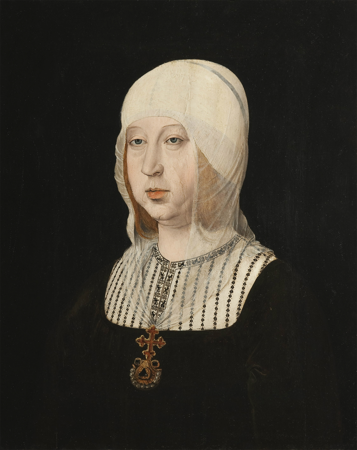
Juan de Flandes (ca. 1465-Palencia, Spain, 1519) was a Flemish painter considered one of the most important representatives of the Spanish Renaissance.

The only conclusive information available on him reveals his work in Castile between 1496 when he entered the service of Isabella the Catholic as court painter and 1519 when he died in Palencia.

Although there is no record of his age when he arrived in Castile in 1496, it may be assumed that he was around thirty years old - at least twenty-five - and therefore was probably born around 1465, or possibly a year or two later. While the surname by which he was known in Castile indicates that he was born in Flanders, this is...
Read more
Isabella I of Castile
Monarch

Isabella I of Castile

(Madrigal de las Altas Torres (Ávila), 1451 - Medina del Campo (Valladolid), 1504)

Daughter of King John II of Castile (1405-1454) and his second wife, Isabella of Portugal (1428?-1496), the future Isabella the Catholic barely knew her father, who died in July 1454.

Her early years were spent in Arévalo (Ávila), in the company of her mother and her brother, the Infante Alfonso (1453-1468). The then-Infanta Isabella was taught by Fray Martín de Córdoba, her tutor, under the supervision of Gonzalo Chacón, Commander of Montiel. Little is known about her childhood education although as an adult, she did learn Latin, the language of culture and diplomacy in late 15th-century Europe, thanks to Beatriz Galindo, also called La Latina. The Infanta Isabella and her brother Alfonso left Arévalo in 1461 to settle at the...

Read more

The work in context

View in Timeline