Use of Cookies

The Royal Collections Gallery uses its own and third-party cookies, mainly for technical purposes, which are necessary to provide our services and provide you with relevant content. More information in our cookies policy. Cookies Policy.

ACCEPT to confirm that you have read the information and accepted their installation. You can change your browser settings.

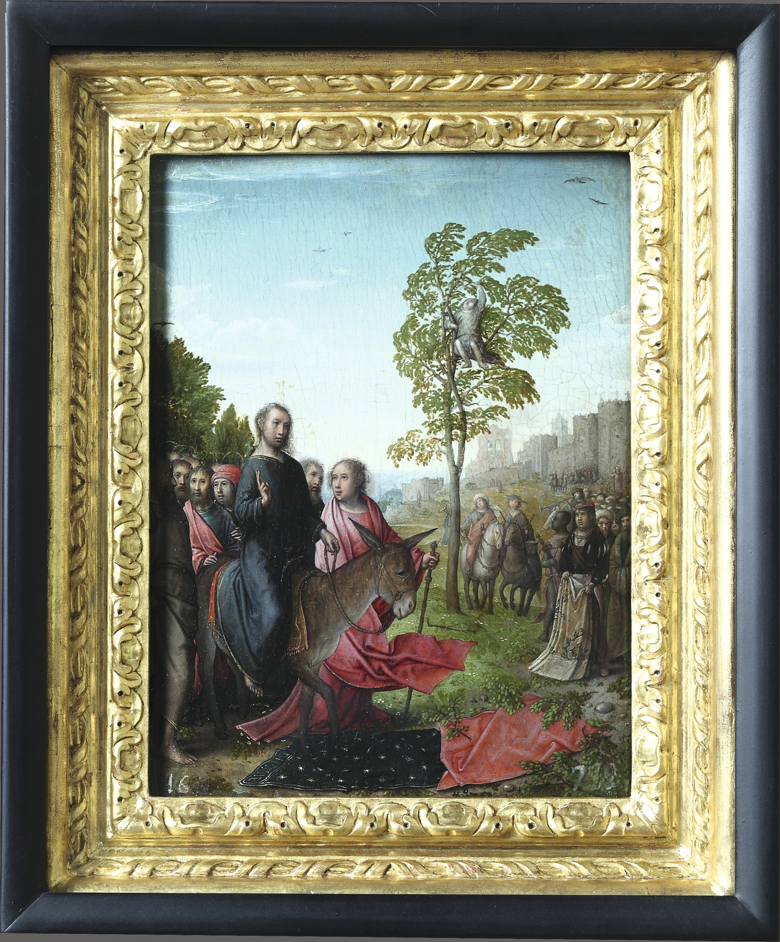
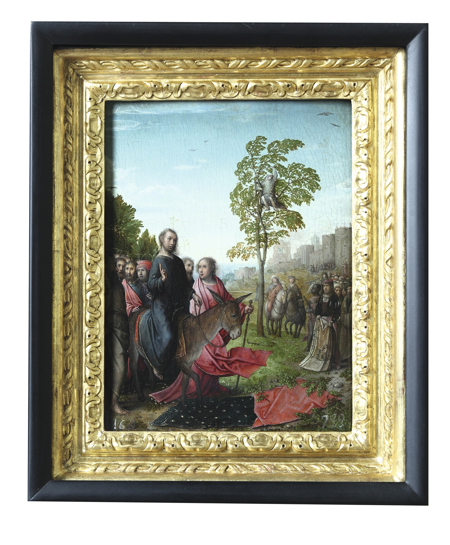
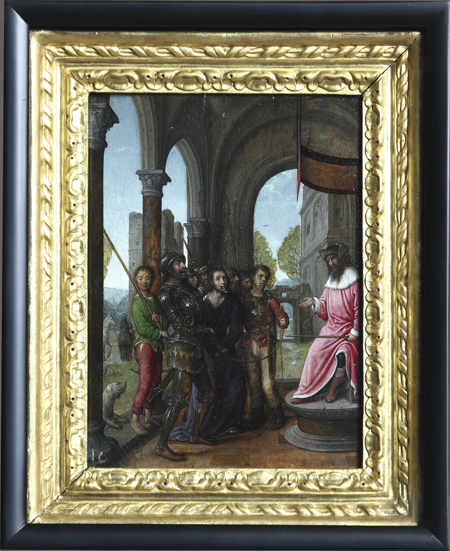
La entrada de Cristo en Jerusalén

Flandes, Juan de
1496-1504

Forma parte del «Políptico de Isabel la Católica», junto a otras escenas de la vida de Cristo. La escena se desarrolla, tal como evocan los evangelios ortodoxos (Mateo 21, 1-11; Marcos 11, 1-11; Lucas 19, 35-39; y Juan 12, 12-18), en un paisaje abierto y de amplios horizontes, el cual queda delimitado a su derecha con la ciudad amurallada de Jerusalén, cuyo perfil con tanta profusión de torres recuerda el de las villas medievales de Castilla. El aire limpio y luminoso del cielo azul y la meseta rocosa del fondo también evocan tierras castellanas. Las aves que surcan el firmamento, como suele ocurrir en muchas de las escenas del conjunto, parecen golondrinas, que prefiguran la Resurrección de Cristo. Un potente árbol solitario, al que está subido un muchacho, sirve de conexión entre el grupo principal de primer término, con Cristo sobre el pollino acompañado de sus discípulos y de otros personajes, y el más numeroso de los habitantes de Jerusalén que salen a su encuentro. Cristo va ataviado con el acostumbrado vestido de un intenso azul oscuro y el nimbo crucífero en dorado, con el que se representa en casi todas las escenas.

El pintor se recrea en la reproducción de las texturas de las telas, especialmente en la de los mantos tirados en el suelo o en el que está todavía por tender, un lujoso tejido de brocado dorado y dibujos en verde. Precisamente el personaje que soporta este manto puede ser reconocido, por sus rasgos fisonómicos de carácter rollizo y por su elegante atuendo cortesano, con Fernando el Católico, el cónyuge de la reina mecenas.

General Classification

Pintura religiosa; Pintura de caballete

Type of Object

Cuadro

By

Flandes, Juan de

Title

La entrada de Cristo en Jerusalén

Collection or Series Title

Políptico de Isabel la Católica

Era / Cultural Context

Reinado de Isabel I de Castilla; Tardogótico español; Tardogótico flamenco; Escuela flamenca

Place of Production

España

Date

1496-1504

Subject

Madera

Display

Tabla

Technical

Pintura al óleo

Dimensions

Fondo enmarcado: (Altura: 26,2 centímetros; Anchura: 21,2 centímetros)

Inventory

10002024

Credits

Texto: Carmen García-Frías Checa

Discover it at the Planta -1

Authors and Collectors

Flandes, Juan de
The Author

Flandes, Juan de

(Belgium?, 1465 - Palencia, 1519)

Juan de Flandes (ca. 1465-Palencia, Spain, 1519) was a Flemish painter considered one of the most important representatives of the Spanish Renaissance.

The only conclusive information available on him reveals his work in Castile between 1496 when he entered the service of Isabella the Catholic as court painter and 1519 when he died in Palencia.

Although there is no record of his age when he arrived in Castile in 1496, it may be assumed that he was around thirty years old - at least twenty-five - and therefore was probably born around 1465, or possibly a year or two later. While the surname by which he was known in Castile indicates that he was born in Flanders, this is...
Read more
Isabella I of Castile
Monarch

Isabella I of Castile

(Madrigal de las Altas Torres (Ávila), 1451 - Medina del Campo (Valladolid), 1504)

Daughter of King John II of Castile (1405-1454) and his second wife, Isabella of Portugal (1428?-1496), the future Isabella the Catholic barely knew her father, who died in July 1454.

Her early years were spent in Arévalo (Ávila), in the company of her mother and her brother, the Infante Alfonso (1453-1468). The then-Infanta Isabella was taught by Fray Martín de Córdoba, her tutor, under the supervision of Gonzalo Chacón, Commander of Montiel. Little is known about her childhood education although as an adult, she did learn Latin, the language of culture and diplomacy in late 15th-century Europe, thanks to Beatriz Galindo, also called La Latina. The Infanta Isabella and her brother Alfonso left Arévalo in 1461 to settle at the...

Read more

The work in context

View in Timeline